
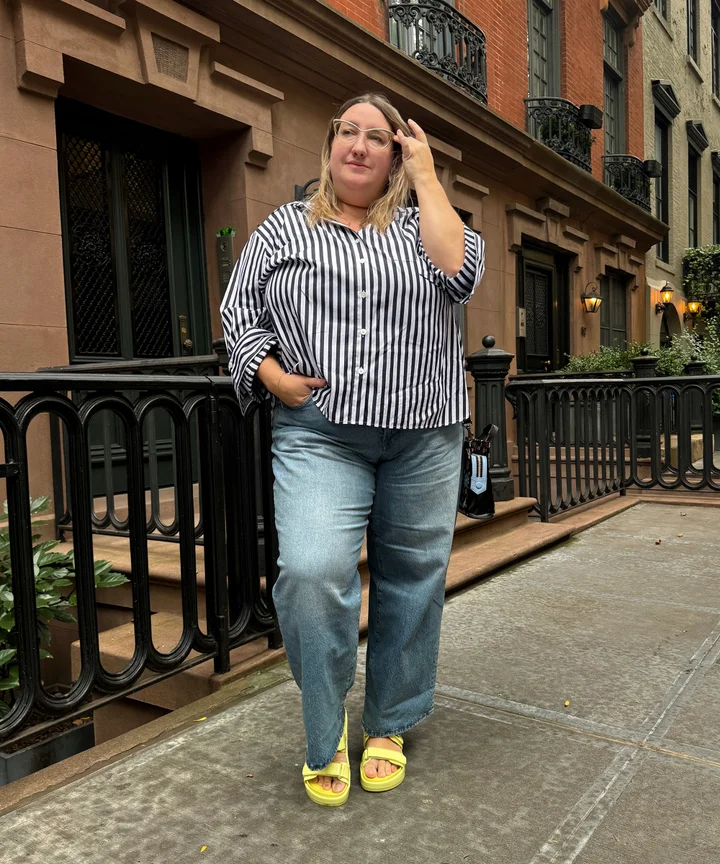
After three years of covering plus-size denim almost weekly, I have watched the baggy jean cycle through three distinct iterations - the carpenter-tinged 2022 version, the slouchier 2023 dad-jean wave, and the cleaner column cut brands are building around for FW25. Every time the silhouette comes back, the same complaint shows up in my inbox: a plus-size reader bought the jean she saw on a size-6 Pinterest model, put it on, and the whole outfit collapsed into a shapeless shape. The jean was fine. The styling was wrong, because nobody told her the rules change above size 14.
Baggy denim on a plus-size frame is a real silhouette, not a compromise version of the trend. Done right it reads as deliberate and runway-aware. Done wrong it reads as borrowed-from-the-boyfriend with no architecture. The difference is four decisions: where the waistband sits, how you handle the tuck, what shoe goes under it, and what proportion the top half is doing. The principles hold across Universal Standard, Eloquii, Good American, Madewell Curvy, and the Old Navy plus extension - the four brands currently making the cleanest baggy cuts above size 18.
What “baggy” actually means on a plus-size body
The word baggy is doing a lot of work right now and it covers at least four distinct cuts. The straight-leg dad jean is column-shaped from hip to ankle with maybe a quarter-inch of taper, sits high on the natural waist, and reads as the cleanest baggy option for plus-size shoppers. The wide-leg, which gets called baggy interchangeably, flares from the knee down. The carpenter or workwear baggy is straight but cut roomier through the seat and thigh with utility detailing. The true slouch baggy has a dropped crotch and exaggerated volume from the hip down.
On a plus-size body those four cuts are not interchangeable, and retail marketing copy will not tell you which one you’re looking at. A straight-leg dad jean in a size 20 from Universal Standard‘s plus line skims the hip and columns down with maybe two inches of ease through the thigh. A true slouch baggy in the same size adds four to six inches of fabric across the seat, which on a size-20 hip is a meaningful amount of additional visual volume. Both are called baggy. Only one is doing the column thing.
The cut to start with, if you have not been wearing baggy denim and want to ease in, is the high-rise straight-leg dad jean. It works across plus-size shapes - hourglass, pear, inverted triangle, rectangle - with minor styling tweaks, and produces a column line that lengthens rather than spreading. Universal Standard‘s Donna and Eloquii’s Wide Leg Trouser Jean are the two I keep coming back to. Build up to the truer slouch once the proportion math is working for you in the cleaner cut first.

The volume rule: anchor the top, let the bottom breathe
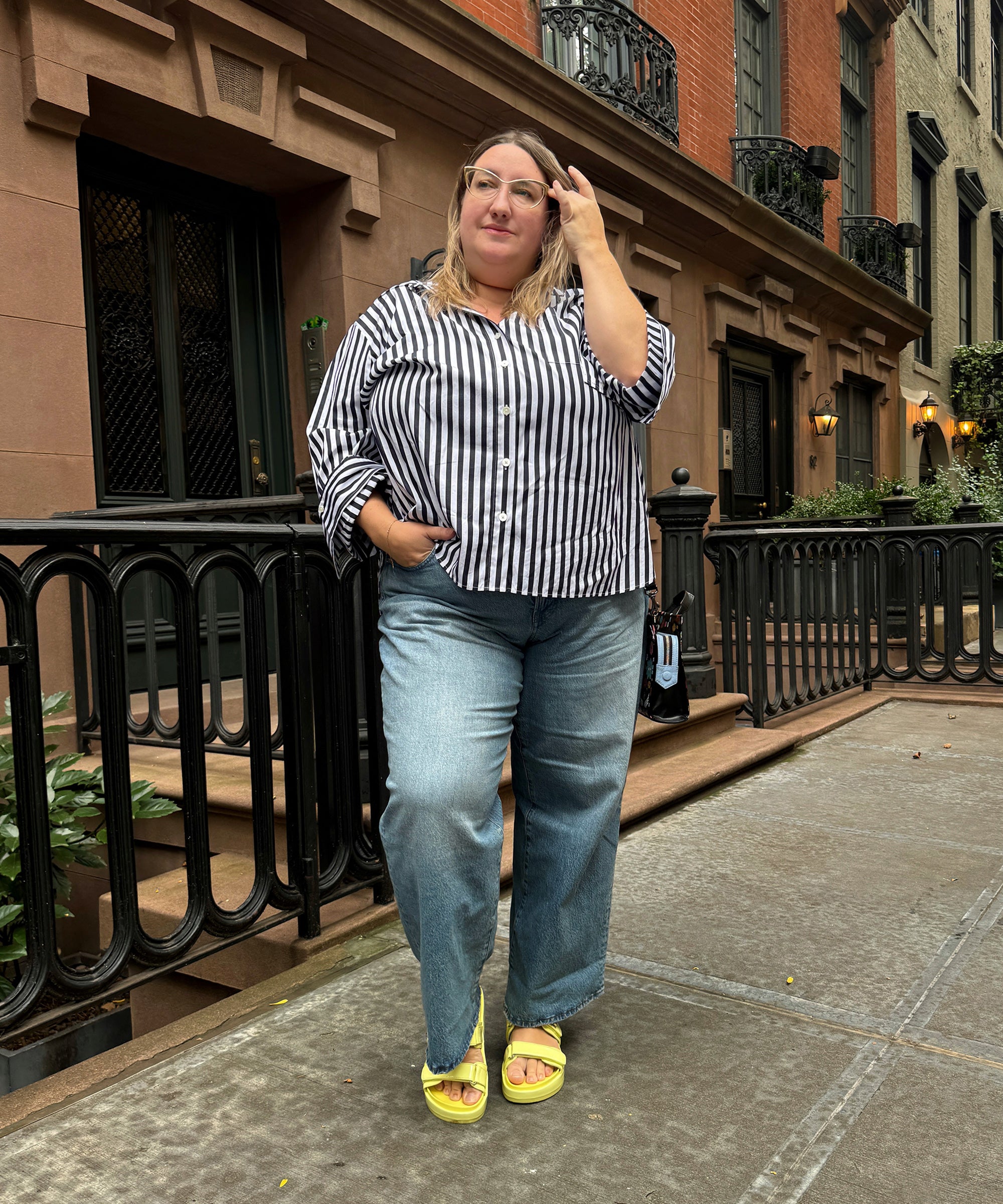
The single most useful principle for styling plus-size baggy jeans is volume balance. The jean is doing the volume work for the outfit, so the top half needs to contain itself. That does not mean tight or compressive. It means fitted at the waist with a clean line through the torso. The pin-saved Pinterest tutorial - cropped baby tee, no tuck, chunky sneaker - is designed for a 24-inch waist where volume contrast creates the look. On a plus-size body that same formula produces one undifferentiated mass from shoulder to floor.
The default formulas that work across shapes: a ribbed tank tucked into the waistband with a slim belt and an unbuttoned shirt or blazer worn open over it - the editor-uniform version, photographs cleanly at any size. A fitted long-sleeve knit, half-tucked at the front waistband so the back hangs naturally and the front signals waist - most forgiving for days you do not want a full tuck. A cropped knit cardigan ending right at the waistband seam, worn over a fitted tank, which lets you skip the tuck entirely. A fitted turtleneck tucked in for cold weather, which extends the column line and reads polished with minimal effort.
What does not work: oversized graphic tees worn untucked over baggy jeans, billowy peasant blouses, drapey cardigans hanging to mid-thigh, hoodies pulled down over the waistband. Each layers volume on volume and erases the waist. You can wear an oversized top with a baggy jean - I do it - but you have to French-tuck the front and accept you are styling for a specific look rather than throwing things on.
Tucks, belts, and the architecture of the waistband
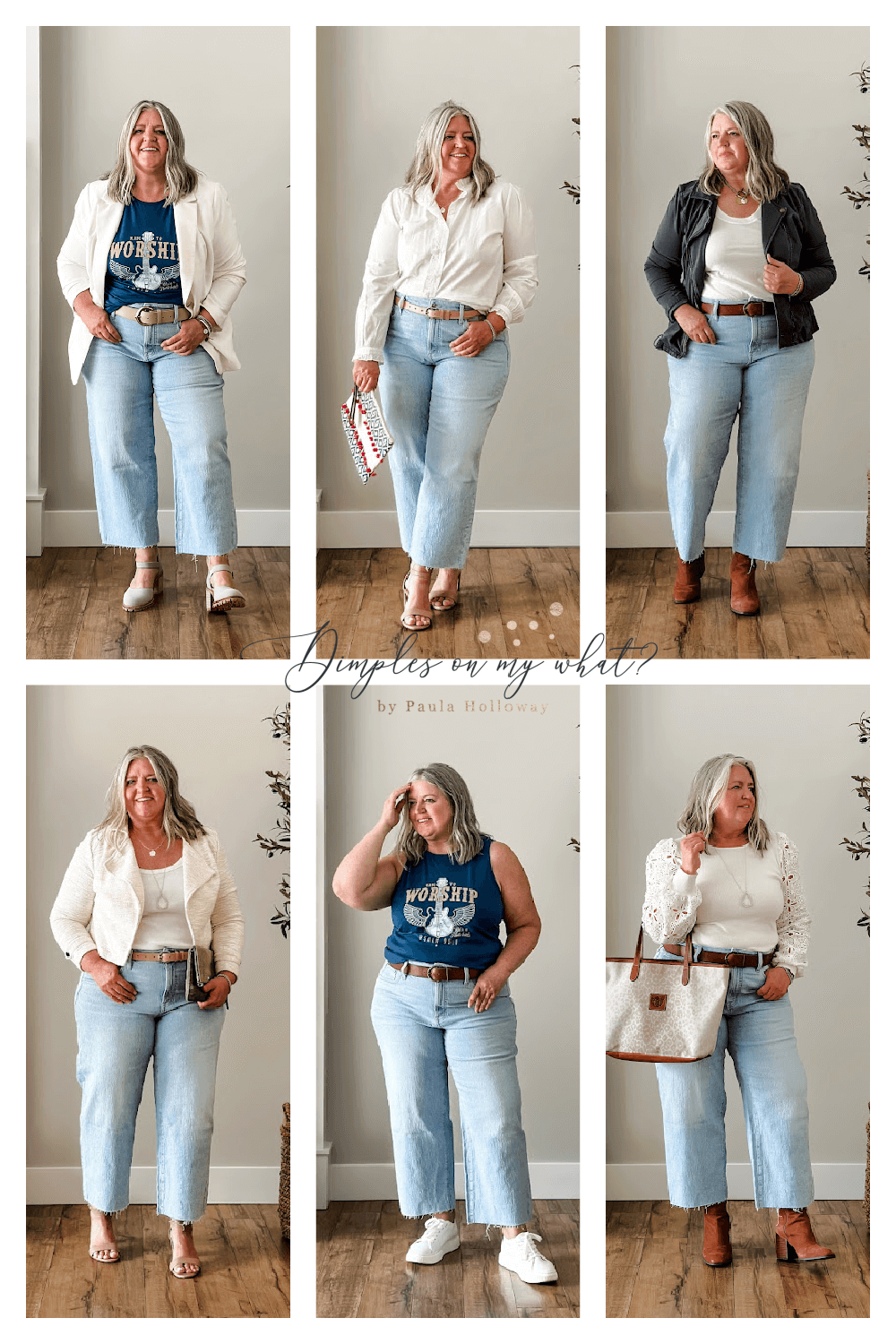
The tuck is the technical move that separates a baggy-jean outfit that works from one that does not. On a plus-size body in a high-rise baggy jean, the waistband sits at the natural waist - the smallest point of the torso. That is the line you want to define. Hiding it under an untucked top throws away the entire shape advantage the jean is built around.
The full tuck works best with thin or medium-weight fabrics. A cotton ribbed tank, a silk camisole, a fine merino sweater. Heavy fabrics like a chunky knit or a structured button-up bunch awkwardly when fully tucked and create bulk at the waistband. For those, use a French tuck or front tuck - tuck only the front center, three to four inches wide, and let the sides and back drape. Waist signal without the bulk.
The belt is the other architectural tool. A slim belt, half an inch to one inch wide, in brown, cognac, or black leather, threaded through the loops of a high-rise baggy jean, does three things at once: defines the waist, adds a horizontal line that balances the proportion, and pulls the outfit out of casual into intentional. Madewell, Universal Standard, and Eloquii all make slim belts in extended sizes. Skip the wide statement belts on a baggy jean - they fight the volume. If your jean does not have functional belt loops, the cropped layer becomes your waist signal instead: a boxy cropped sweater, a leather jacket cut at the natural waist, a structured cardigan with a deliberate hem at the waist.
Shoes that make a baggy jean read intentional
Shoes are where most plus-size baggy-jean outfits go wrong, and the mistake is almost always going too chunky. The instinct is reasonable: if the jean is voluminous, a substantial shoe should balance it. The reality on a plus-size frame is that a chunky sneaker or platform boot under a wide-leg jean reads as one unbroken mass from knee to floor and adds visual weight at exactly the ankle, which is where you want the line to taper.
The shoes that work, ranked by how reliably they look intentional: a slim loafer in brown or black leather, which lets the hem break cleanly over the top of the shoe. A pointed-toe flat or low pump, which extends the line of the leg through the foot. A clean low sneaker - a leather Vionic, a Naturalizer, an Allbirds Tree Runner - casual without ankle bulk. A western ankle boot with a slim shaft, which slides under the hem of a wide-leg jean and disappears.
Hem length matters more than most people realize. A baggy jean should hit either right at the top of your shoe with a slight break, or be cropped at the ankle bone. Hems pooling three or four inches of fabric on top of the shoe read as ill-fitting regardless of how good the jean is. If your jean is too long, get it hemmed at a local tailor - twelve to fifteen dollars and the outfit upgrades.
Layering jackets and outerwear over the volume
Outerwear with a baggy jean is the place to introduce structure back into the outfit. The baggy half is below the waist; everything above can be more architectural. The jackets that work hardest with this silhouette are the ones with a defined shoulder and a hem at or just below the natural waist. A cropped leather moto jacket, a boxy cropped denim jacket worn over a tucked tank, a tailored blazer in wool or linen, a fitted bomber with a banded waist.
Longer coats also work, but the rules change. A long wool coat or trench in a clean line - knee-length or longer, single-breasted, with a defined shoulder - looks polished over baggy jeans because it creates a vertical column that contains the volume. A long puffer or oversized parka adds bulk to bulk and turns the outfit into a marshmallow situation. If you want a puffer, get a cropped one that ends at the natural waist and lets the jean continue the line.
For the in-between weather most of us live in eight months a year, the combination I default to is a fitted long-sleeve knit, baggy jean, slim belt, loafer, and an unbuttoned button-up worn open as a layer. The unbuttoned shirt acts like a lightweight cardigan, adds a third color or pattern, and keeps the shoulders defined without committing to a jacket. J.Crew’s plus extension and Madewell Curvy both make this kind of layering shirt in size-inclusive runs.
Troubleshooting the most common baggy-jean fails
If the outfit feels off in the mirror and you cannot name why, run through these diagnostics in order. They are the failure modes I see most often, and most are fixable in under sixty seconds.
First, the lost waist. If the outfit reads as a single shape from shoulder to ankle, you are missing the waist signal. Fix: tuck the top, add a slim belt, swap to a cropped layer that ends at the waistband, or front-tuck if a full tuck looks bulky. Pick one and the outfit reorganizes. Second, the swallowed shoe. If your hem is pooling over the top of your shoe in three inches of stacked fabric, the jean is too long. Get it hemmed, or roll the hem once for a structured cuff that lets the shoe become visible again.
Third, the top-heavy collapse. If your shoulders or bust feel like they are dominating the outfit and the jean is reading as an afterthought, your top has too much volume relative to the bottom. Switch to a fitted top, or add a slim belt to reintroduce waist definition. The baggy jean should be the loudest piece in the outfit, not the quietest. Fourth, the saggy seat. If the jean is bagging out behind you within an hour of wearing it, the fabric has too much elastane and is overstretching without recovering, or you sized down. Look for 92-98 percent cotton with 2-6 percent elastane - Universal Standard and Madewell Curvy consistently land there.
The pieces worth investing in
The minimum kit for styling baggy jeans well across a season is smaller than you would think. One pair of high-rise straight-leg dad jeans in a dark wash from a curve-engineered brand - Universal Standard’s Donna wide-leg is my pick because the rise actually hits at the natural waist on a plus-size body and the fabric weight holds shape. Two or three ribbed tanks in white, black, and cream from Old Navy’s plus extension or Madewell Curvy. A slim leather belt in cognac or brown - a Madewell belt in extended sizes runs around $40 and lasts. A pair of loafers in brown or black leather; Naturalizer and Cole Haan both carry wide widths in styles that hold up.
To extend the formula across a season, add a cropped denim jacket, a cropped cardigan in cream or oatmeal, and a fitted black turtleneck. Eloquii’s Wide Leg Trouser Jean in dark indigo is the polished variation if you want a second pair that dresses up easier than a dad jean.
Frequently asked questions
Can I wear baggy jeans if I am short (under 5’4″)?
Yes, with adjustments. Look for a cropped wide-leg or cropped straight-leg version, which most brands now carry at 24-26 inch inseams. If you can only find regular length, get it hemmed to the ankle bone - twelve to fifteen dollars at any tailor and the volume stops overwhelming your frame. Pair with a pointed-toe shoe rather than a flat round-toe to add visual length to the leg. The fitted top half is non-negotiable at shorter heights because volume contrast matters more.
Are baggy jeans flattering on plus-size pear shapes specifically?
They can be, and they are one of the better cuts for pear shapes when styled correctly. The volume in the leg balances the volume in the hip, creating a column line that reads proportional rather than bottom-heavy. The rule for pears specifically is to keep the volume even from hip to ankle (straight-leg dad jean) rather than flaring from the knee, because the flare can amplify hip width. Pair with a fitted top and a belt to define the waist.
How baggy is too baggy for a plus-size body?
If you cannot pinch and find a defined waistband at the natural waist, the jean is too baggy for flattering plus-size styling. The waistband is the architectural anchor of the entire outfit, and a true slouch jean with a dropped or loose waist removes that anchor. Stick with cuts that sit firmly at the natural waist (high-rise, 11 inches or more in the front rise) and have a defined waistband seam. The volume below the waist can be substantial; the waistband itself should not be.
What about wearing baggy jeans to work?
Depends on the dress code, but a tailored take on the silhouette works in most business-casual environments. Swap the dad jean for a wide-leg trouser jean in dark indigo or black, tuck a fitted silk shell or fine merino knit in, add a slim belt, finish with a pointed loafer or low pump. A blazer worn open over the top reads as office-appropriate. The Eloquii Wide Leg Trouser Jean is the version I recommend most often for work because the fabric is heavier.
Final word
Styling plus-size baggy jeans well is mostly about respecting the architecture: anchor the waist, contain the top, pick a shoe that does not double the ankle, and let the jean be the loudest piece. The one I keep reaching for is Universal Standard‘s Donna wide-leg in dark indigo, size 18, around $98 on the Universal Standard site - it has held shape through twenty wears and a half-dozen washes, and it works under a tucked tank, a cropped cardigan, or a blazer with equal ease. Buy that one, hem it if you need to, and the rest of the outfits build themselves around it.