
Every curvy woman has a version of the same fitting-room story. You find jeans that finally slide over your thighs and hips, you do a happy little shimmy, and then you turn around and there is a three-inch canyon gaping at the back of your waistband. Or the reverse: the waist fits like it was made for you, but the denim simply refuses to travel past your thighs. You leave with nothing, again, half-convinced your body is the problem. It is not. Straight-size jeans are cut for a body shape that most of us do not have, and once you understand what actually causes the gap and the squeeze, you can shop for the features that fix them instead of hoping.
I have bought and returned more jeans than I care to admit, and the turning point was realizing that fit is engineering, not luck. A handful of construction details separate jeans that hug your curves from jeans that fight them. Here is what to look for, written for real plus-size and curvy bodies rather than the narrow mannequin most denim is designed around.
Why the back waist gaps in the first place
The gap is not a flaw in you, it is a mismatch between your proportions and the pattern. If you have a defined waist that sits well in from your hips, which describes a huge share of curvy and hourglass bodies, then jeans cut on a straighter line will fit your hips and leave slack at the smaller waist. The denim has more fabric across the top than your middle needs, so it stands away from your back and gaps. Pear and hourglass shapes get this constantly, because the hip-to-waist difference is exactly what standard grading ignores.
Apple shapes hit the opposite wall. If you carry weight around your middle, a low or mid-rise pair digs in under the belly, rolls down, and creates that unflattering muffin over the top. In both cases the fix is not a smaller size, which just makes everything tighter and more uncomfortable, but a different cut designed for the way your waist and hips actually relate. Naming the cause matters, because it points you straight at the two features that solve it.
The waistband is everything
If there is one detail that decides whether a pair of jeans works on a curvy body, it is the waistband. Look for a contoured or curved waistband, sometimes sold as a no-gap or Waist-Match band, which is cut to follow the inward curve of your waist instead of running in a straight line. Better still is a hidden inner elastic band, which quietly cinches the top to your actual shape so it stays flush against your back no matter how much smaller your waist is than your hips.
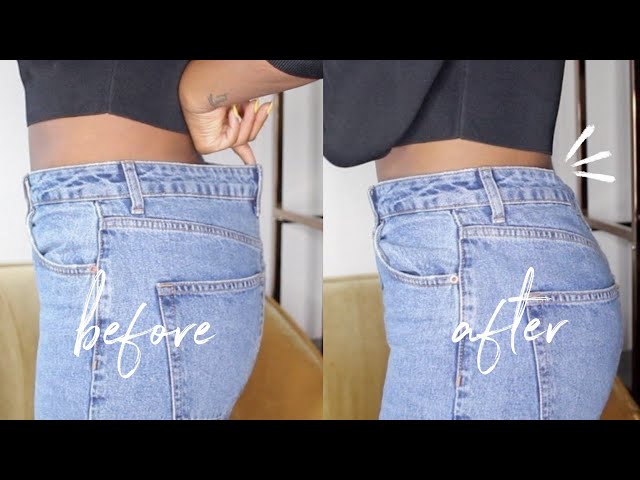
This single feature fixes the number one complaint curvy women have about jeans, and once you have worn a properly contoured band you will never happily go back to a straight one. Brands like NYDJ and Democracy build hidden inner panels and curved bands into their signature fits, and it is the reason their jeans sit smooth across the back when generic pairs stand away. When you shop, read the product description for the words contoured, curved, no-gap, or hidden elastic, and treat a plain straight waistband on a curvy-marketed jean with healthy suspicion.
Rise: why high-waisted holds everything in place
Rise is the height from the crotch seam to the top of the waistband, and for most curvy and plus-size bodies, high-rise is the answer to more problems than any other single choice. A high rise sits above your hips and comes up over the softest part of your stomach, so it holds your midsection gently, stops the waistband sliding down as you move, and closes the gap at the back by sitting at the narrower part of your torso. It also gives you real coverage, so you are not tugging your jeans up every time you stand.
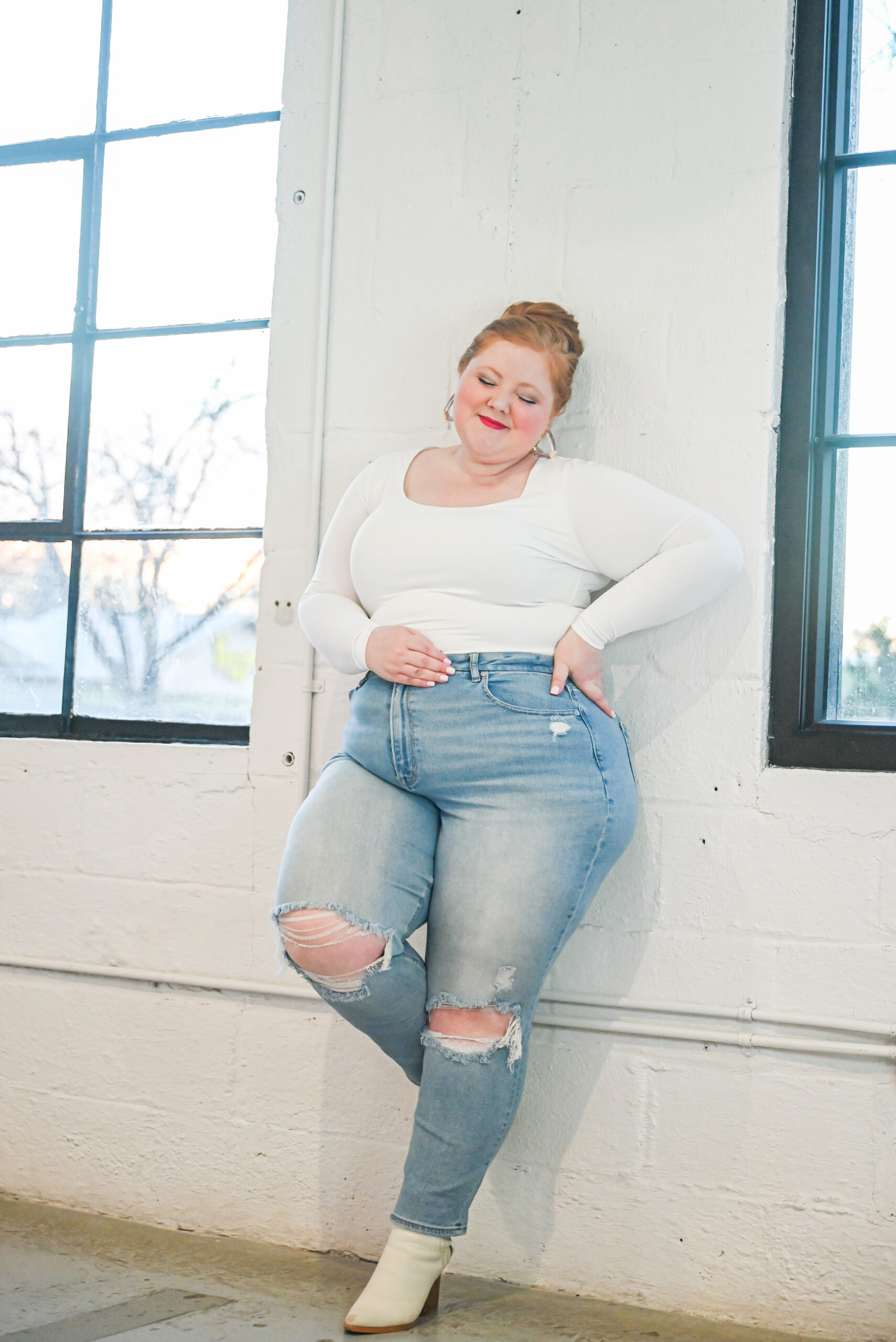
Low-rise works against a curvy midsection almost every time. It perches on the widest part of your hips and belly with nothing to anchor it, so it rolls, digs, and makes the middle look larger rather than smoother. If you are an apple shape especially, high-rise is not a trend to consider, it is the structural fix for the exact discomfort you have been fighting. Short-waisted bodies sometimes find a super-high rise hits the ribs, so look for a rise around ten to eleven inches rather than the very tallest, and you get the hold without the fold.
What tummy panels do, and what they do not
A lot of curve-focused jeans now include some kind of tummy-control panel, and it helps to know what you are actually buying. A good panel is a slightly firmer internal layer across the front that smooths the midsection and stops the waistband from folding over when you sit. It gives a cleaner line under a fitted top and takes the edge off the dig. What it does not do is transform your shape or act like shapewear, and a panel that is too aggressive just creates its own roll at the top, so you want smoothing, not squeezing.
Pair a modest tummy panel with the right rise and you get a genuinely comfortable, smooth fit. Treat the panel as a nice-to-have that supports the two features that really matter, the contoured waistband and the high rise, rather than as the headline fix on its own. If a jean leans hard on aggressive compression to compensate for a straight waistband, it will still gap and still dig, just with more effort.
Fabric: enough stretch to move, enough recovery to hold
Denim with some stretch is your friend on a curvy body, but stretch alone is only half the equation. The word that matters more is recovery, which is the fabric’s ability to snap back to shape instead of bagging out. A jean with good stretch but poor recovery feels great for an hour, then sags at the knees and seat and grows a whole size by mid-afternoon, so you spend the day hiking them up. Look for a cotton blend with elastane plus a recovery-focused fiber, and check reviews specifically for whether they bag out.
The trade-off runs the other way too. A rigid, non-stretch jean holds its shape beautifully but can be brutal to get over full thighs and unforgiving when you sit. For most of us the sweet spot is a mid-weight stretch denim with strong recovery, which moves with your body through a full day and still looks sharp at dinner. If you live in your jeans, spending a little more on fabric quality pays off every single wear.
Cuts that flatter, and the thigh-wear problem
Once the waistband and rise are right, cut is where you get to have fun. Wide-leg, bootcut, and slim-straight styles all balance fuller hips and thighs beautifully, and a slight flare below the knee lengthens the whole line. Skinny jeans can absolutely work on a curvy body, they just demand the best waistband and recovery you can find, because they have the least room to hide a poor fit. The honest issue many of us know well is thigh wear, where the denim rubs through between the legs long before the rest of the jean is worn out.
Thigh wear comes from friction and thin fabric, so a slightly heavier denim with good recovery lasts far longer, and choosing a cut with a touch more room through the thigh reduces the rub. Brands that design for curves tend to reinforce these stress points. ELOQUII and Universal Standard both cut genuinely curve-first jeans, and a well-made curve-fit high-rise jean fits the waist and the thigh at once instead of forcing you to choose. For everyday value, Torrid and Lane Bryant cut their denim for plus-size proportions rather than grading up, so a high-rise jean with a contoured waist from either sits smooth at the back. And if you want a hidden-panel classic, a pair of tummy-control bootcut jeans covers the waistband, rise, and cut in one go.
Quick answers to the questions everyone asks
How do I stop my jeans gaping at the back waist? Choose a contoured or curved waistband, ideally with hidden inner elastic, which follows the inward curve of your waist instead of running straight. Pair it with a high rise that sits at the narrower part of your torso. The gap is a proportion mismatch, not your size, so a smaller pair will not fix it.
What jeans are best for a big belly or apple shape? High-rise jeans with a smoothing tummy panel and a contoured waistband. The high rise sits above the belly and holds it gently instead of digging in and rolling down the way a low or mid rise does. Avoid stiff, low-rise cuts, which are the exact combination that digs and creates a muffin.
What should I look for in high-waisted tummy-control jeans? A rise around ten to eleven inches, a contoured or hidden-elastic waistband, a smoothing rather than aggressively compressive front panel, and denim with good recovery. Those together give a smooth, held midsection that stays put all day without folding over or bagging out at the knees.
Why do my jeans wear out between the thighs? Friction plus thin fabric. When your thighs touch, the denim rubs with every step and eventually thins and splits, usually long before the rest of the jean is worn. A heavier-weight denim with good recovery and a cut with a little more thigh room lasts much longer against that rub.
Which plus-size jeans hold their shape? The ones with strong recovery in the fabric, not just stretch. Stretch lets them move, recovery makes them snap back instead of bagging at the knee and seat. Check reviews for whether a pair sags or grows through the day, and lean toward mid-weight stretch denim from curve-focused brands.
What rise is best if I’m short-waisted and plus-size? Aim for a high rise around ten to eleven inches rather than the very tallest available, which can hit your ribs and fold. You still get the hold and gap-closing benefit of a high waist without the top edge digging into your midsection when you sit down.
Your simple shopping checklist
Next time you are staring down a wall of denim, run through five quick questions. Does it have a contoured or hidden-elastic waistband? Is it a high rise that comes over the softest part of your stomach? Does the fabric list good recovery, not just stretch? Is the cut, wide-leg, bootcut, or slim-straight, one that balances your hips? And does the thigh have enough room to move without rubbing thin? Get most of those yeses and you have found jeans that fit your body instead of fighting it, no back-waist canyon required.