
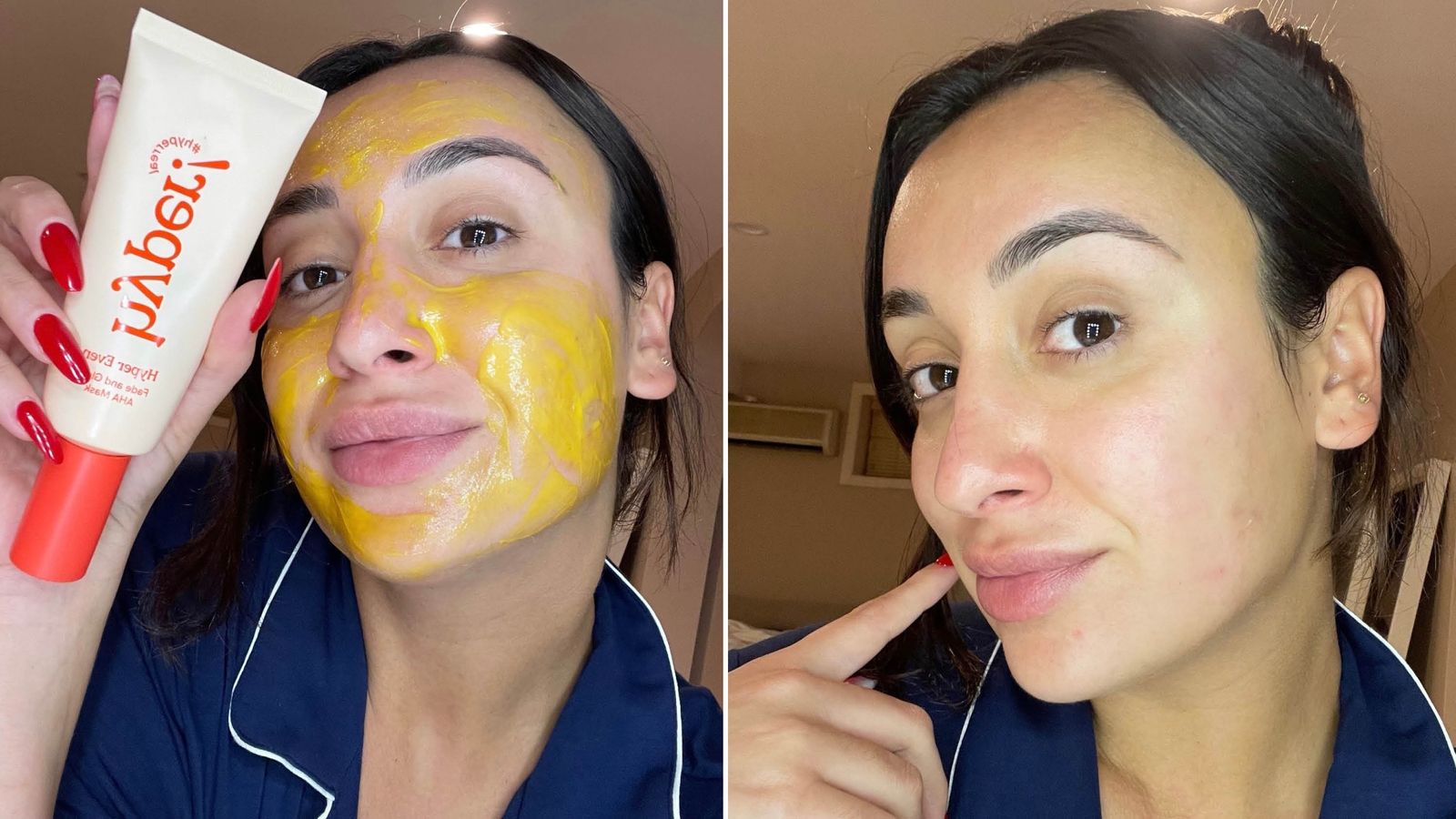

Body hyperpigmentation gets far less serious coverage than facial discolouration, which is strange given how common it is. Marks from chafing, from ingrown hairs, from razor irritation, from a bra strap that sits in the same place every day: these are post-inflammatory hyperpigmentation, the same process that follows a spot on the face, and they are more pronounced and longer-lasting on deeper skin. Hyper Skin’s vitamin C serum is one of the products most often recommended for them, usually by people using it on their cheekbones. This article does three things instead of reviewing it: it sets out what is actually in the formula, what the published evidence supports for each of those ingredients on deeper skin, and where the brand currently stands, because that last part has changed and it matters before you plan a routine around one bottle.
What the product is, as the brand publishes it
First, a naming correction, because the old name is still all over the internet. The product formerly sold as Hyper Clear is now published as Hyper Even Brightening Dark Spot Vitamin C Serum, at $36 on the brand’s own site as of 3 November 2026. Hyper Skin is an independent, Black-owned brand built around hyperpigmentation on melanin-rich skin, which is a meaningful positioning given how much pigmentation research has historically been done on lighter phototypes.
Two things the brand does not publish are worth knowing up front. There is no size or volume stated on the product page, which makes cost per use impossible to calculate honestly. And there is no body-specific product in the range at all, and no brightening face cream either. The current catalogue is five items: a cleansing gel, an AHA mask, this serum, an SPF 50 product, and a deluxe mini duo. So using this serum on inner thighs, underarms or a bra-strap band is an off-label use of a face product, which is not necessarily wrong but is not what it was formulated and tested for.
The brand’s own claims, in its words: the formula is built on vitamin C at 15%, with kojic acid at 1% and salicylic acid at under 1%, supported by bearberry, licorice and turmeric. It is published as vegan, cruelty-free and hydroquinone-free. Directions are once daily in the morning, followed by moisturiser, with sunscreen applied liberally before sun exposure. One internal inconsistency is worth flagging: the marketing copy refers to a more even complexion in just 30 days, while the brand’s own FAQ says results are usually notable after 39 days for newer marks and longer for older ones. On pregnancy, the FAQ states that the products contain active ingredients and botanicals, some of which your doctor may advise avoiding during pregnancy or while nursing, which is the correct answer and a reason to ask yours.
The full published ingredient list
This is the whole list as published on the brand’s product page on 3 November 2026, in order. It is reproduced in full because the specific forms matter and most coverage of this product paraphrases them.
Water (aqua), 3-O-ethyl ascorbic acid (vitamin C), kojic acid, aloe barbadensis leaf juice, arctostaphylos uva-ursi leaf extract, biotin, camellia oleifera leaf extract, citric acid, corallina officinalis extract, curcuma longa (turmeric) root extract, ethylhexylglycerin, glycerin, glycyrrhiza glabra (licorice) root extract, hyaluronic acid, hydroxyethylcellulose, lactobacillus/papaya fruit ferment extract, lecithin, maltodextrin, melia azadirachta flower extract, melia azadirachta leaf extract, ocimum basilicum (basil) flower leaf extract, ocimum sanctum leaf extract, phenoxyethanol, phyllanthus emblica fruit extract, potassium sorbate, pullulan, pyrus malus (apple) fruit extract, saccharomyces/xylinum/black tea ferment, salicylic acid, sclerotium gum, silica, sodium benzoate, sodium citrate, tetrasodium edta, tocopherol, xanthan gum.
One detail in that list changes how you should read every efficacy claim about it. The vitamin C here is 3-O-ethyl ascorbic acid, a derivative, not L-ascorbic acid. Derivatives are more stable in a water-based formula, which is a genuine formulation advantage, but the published pigmentation research on topical vitamin C is overwhelmingly on L-ascorbic acid. Evidence for one form is not automatically evidence for the other, and nobody should present it as though it is.
What the evidence actually supports for pigmentation on deeper skin
Start with the single most relevant piece of literature, because it reframes everything else. A 2024 systematic review in the Journal of Cutaneous Medicine and Surgery (Nguyen and colleagues) pooled 48 studies covering 1,356 skin-of-colour patients with post-inflammatory hyperpigmentation, the majority Black. Its conclusion, verbatim, is that the results show a lack of robust efficacy across all treatment modalities, and that treating this condition poses challenges and can potentially worsen it. Only three approaches showed notable success over no treatment: a specific tyrosinase inhibitor called thiamidol, laser, and topical retinoids. The authors also raise their own confounder, which is that around two-thirds of untreated patients had partial resolution over time, so improvement during treatment cannot automatically be credited to the treatment.
Against that backdrop, here is where each relevant ingredient sits. Topical retinoids have the strongest topical evidence in skin of colour, and it is moderate rather than strong: in the pooled data no patient achieved complete resolution, 64% of 118 showed partial pigment reduction, and 14% did not respond. Azelaic acid has moderate evidence for melasma and is extrapolated to post-inflammatory marks from small acne studies rather than from trials with pigmentation as the endpoint. Niacinamide rests largely on one small split-face trial of 27 patients against 4% hydroquinone, which found no statistical difference on colorimetric measures. Kojic acid, which is in this formula at 1%, has limited to moderate evidence for melasma and the weakest effect size of the agents that reached significance in a 2023 pooled analysis, with low reported irritation; there is no skin-of-colour data for it on post-inflammatory marks. Vitamin C is weaker than its reputation suggests: it ranked fifth of fourteen therapies in a network meta-analysis of melasma treatments, an indirect comparison, and was absent from the main pooled efficacy analysis. The 2024 review states plainly that for vitamin C derivatives, azelaic acid and cosmeceuticals there are no available studies with specific results for skin-of-colour patients with post-inflammatory hyperpigmentation.
Two further notes for context. Tranexamic acid performs well for melasma but has not been evaluated as an intervention once post-inflammatory marks have already formed. And alpha arbutin, which appears constantly in budget recommendations including The Ordinary’s version at Ulta, appears in none of the systematic reviews or professional guidance checked for this article. That is not proof it does nothing. It means no published efficacy evidence was found, and it should be described that way rather than as a proven cheaper alternative.

The risk that most product coverage leaves out
Here is the part that matters most on deeper skin, and it is not a hedge. Post-inflammatory hyperpigmentation is caused by inflammation: inflammatory mediators activate melanocytes, which deposit more pigment. That means anything that irritates the skin can make the marks worse rather than better. Callender and colleagues put it directly in American Journal of Clinical Dermatology in 2022: the goal of treatment is to maximise efficacy while minimising irritation, because irritation can exacerbate hyperpigmentation in patients with skin of colour. The same paper explicitly attacks the popular belief that stinging means a product is working, and advises against toners and astringents that over-dry the skin.
That applies to several things people reach for first. The retinoid literature flags retinoid dermatitis as a specific route to more pigmentation in deeper skin, with lower starting concentrations, moisturiser and slow titration as the published mitigations. On chemical exfoliation the 2024 review is blunter still: people with skin of colour have a well-documented elevated risk of developing transient hyperpigmentation after peels, and peels should not be routinely recommended as a first-line treatment in this group. Salicylic acid specifically did not show significant reductions in post-inflammatory marks in that pooled data and showed increased adverse effects. The AAD’s consumer guidance says the same thing in plainer language: when a skin or hair care product irritates your skin, the product can cause dark spots, and if a product burns or stings when you apply it, stop using it.
Two further warnings from the published literature, because they are genuinely serious. Long-term use of hydroquinone-containing lightening creams is associated with exogenous ochronosis, a dyschromia that primarily affects people with skin of colour and in which the skin paradoxically darkens, often worsening the original problem and making it harder to treat. Published case series report it disproportionately in the deepest Fitzpatrick types, after years of unsupervised use, and in some reports at concentrations as low as 2%. Treatment is described in the reviews as unsatisfactory. Separately, the AAD warns that imported skin care products have been found to contain steroids or mercury that were not listed on the label, and that the steroids can leave skin thin, fragile or permanently discoloured. Its guidance also includes the line: never use liquid bleach. If the marks are persistent, widespread, or you are not sure what caused them, that is a reason to see a board-certified dermatologist rather than to escalate on your own, because some treatments for pigmentation carry a real risk of worsening it on deeper skin.
Sunscreen is the step that makes the rest work
This is the best-supported recommendation in the whole category and it is the one most often skipped. The AAD states that effective treatment for dark spots and patches begins with sunscreen, and it sequences sunscreen ahead of actives: once you remove what is causing the dark spots and protect the skin from light, a fading product tends to be more effective. A 2021 expert panel consensus in the Journal of the European Academy of Dermatology and Venereology (Passeron, Lim, Goh and colleagues) goes further for darker skin, stating that ambient light is sufficient to promote post-inflammatory hyperpigmentation in dark skin and that broad-spectrum tinted sunscreen including protection against high-energy visible light is mandatory. The same paper notes a trial in which a sunscreen protecting against both ultraviolet and visible light improved the depigmenting efficacy of hydroquinone compared with an ultraviolet-only sunscreen.
The practical detail is iron oxide. Both the AAD and the consensus paper recommend tinted sunscreens containing iron oxides, and the AAD gives a genuinely useful tip: because iron oxide protects against visible light rather than ultraviolet, it is listed among the inactive ingredients, so that is where to look on the bottle. Two honest limits. The randomised evidence for tinted sunscreen is almost entirely in lighter phototypes, so for Black and brown readers this recommendation rests on mechanism plus trials in lighter skin rather than on trials in the deepest skin tones. And the 2024 review notes that while sunscreen’s role in preventing these marks is documented, whether it offers the same benefit for treating marks that already exist remains unanswered.
Where the brand currently stands, and why that matters before you commit
As of 3 November 2026, all five products in the Hyper Skin catalogue are listed as sold out on the brand’s own site, and the product images on the serum page are placeholder graphics rather than photography. The brand’s footer carries a link headed “Support Our Preorder Campaign”, which leads to a crowdfunding page titled around raising $150,000. The preorder collection’s own published description explains that ordering helps the brand reach the minimum quantities it needs to replenish these formulas, and that collection now contains a single sold-out item. Separately, Sephora’s Hyper Skin brand page returns zero results and states that no products match, so the brand appears to have been delisted there even though some Hyper Skin search pages at Sephora still exist.
None of that is a judgement on the formula, and small Black-owned beauty brands have been squeezed hard in the last two years. It is a practical caution. Pigmentation routines only work if you can keep using the same product for months, and a product you cannot currently buy is a poor foundation for a plan that depends on consistency. The same applies to any star rating you see quoted for it: the brand’s own review widget does not render a readable figure, and with the Sephora listing gone there is no retailer rating to check either, so treat any specific rating or review count you encounter for this product as unverifiable right now. Another product commonly compared against it, Topicals Faded at Sephora, is worth checking the same way: read its published ingredient list against the evidence summary above rather than against the marketing, and note where it leads with acids, given what the literature says about exfoliation and deeper skin.
Frequently asked questions
Will a vitamin C serum clear friction marks on inner thighs? Nobody can honestly promise that, and the published evidence does not support a confident yes. The systematic review covering this exact population found a lack of robust efficacy across every treatment studied, with partial improvement at best and no complete clearance from topicals. What is more certain is the mechanism: these marks follow inflammation, so reducing the ongoing friction with an anti-chafe balm or a short layer under clothing addresses the cause rather than the symptom. That is not an upsell. It is the part the serum cannot do.
Can I use it on freshly shaved or waxed skin? Given what the literature says about irritation driving more pigmentation in deeper skin, compromised skin is exactly when to wait. If there is a nick, razor burn or any stinging, leave it. More broadly, if a product stings on application, the AAD’s guidance is to stop using it rather than to push through.
How does this compare with a dermatologist’s prescription? Over-the-counter hydroquinone was removed from the US market under the 2020 CARES Act, so prescription routes now go through a clinician, which is where they belong given the ochronosis risk described above. In the pooled skin-of-colour data, hydroquinone was used by only 7% of patients and showed no superiority over alternatives for post-inflammatory marks, while carrying the highest irritation rate of the agents analysed. Retinoids, laser and thiamidol were the three approaches that showed notable benefit, and all three are conversations to have with a dermatologist rather than purchases to make alone.
Does it work on the face too? It is a face product, so facial use is what it was formulated for. Facial skin is thinner and turns over faster than skin on the thigh or the back, which is a reasonable mechanistic argument for different behaviour, though no study comparing the two was found.
How to read any dark spot product, including this one
The useful summary is not a score. It is a way of reading the category. Check which form of an active is in the formula, because the published evidence attaches to specific forms and 3-O-ethyl ascorbic acid is not L-ascorbic acid. Check whether a product is formulated for the body if you plan to use it on the body. Check whether the brand can actually supply it for the six months a pigmentation routine takes. Put sunscreen, ideally tinted with iron oxide, ahead of the serum in your order of priorities rather than after it, because that is the step with the strongest support. And treat irritation as a stop signal rather than a sign of progress, because on deeper skin irritation is a documented route to more pigment, not less.
Most importantly, keep the frame straight. These marks are not a flaw to be corrected before you are allowed to wear what you want. They are a common skin response to friction and inflammation, they often fade on their own over time, and the published evidence for every available treatment is more modest than the before-and-after grids suggest. If they are persistent, spreading, or you cannot identify the cause, see a board-certified dermatologist, because pigmentation on deeper skin tones is one of the areas where the wrong treatment genuinely can make things worse.
A note on health information. This article is general information and not medical advice. It is not written by a clinician and it cannot account for your own history, medications or circumstances. Please speak to a qualified healthcare professional before starting, stopping or changing any treatment, medication or supplement, and seek professional support if something here raises a concern about your own health.