

After three years of covering this category and watching every major lingerie brand build, buy, or buy out its own bra-size calculator, I can tell you that most of them give you a size that sells at their price point rather than a size that fits your body. The calculators at Victoria’s Secret, Aerie, and the budget Amazon-brand pages will round you into the band-and-cup combination they have the most inventory of, usually a 34B through 38DD, regardless of what the math says. The Curvy Couture, Cuup, and Bare Necessities calculators are the three I send people to first because they are built around the math, not the warehouse.
This guide is the version of the conversation I have had with maybe forty friends and one patient bra fitter in a Brooklyn lingerie shop who told me my measuring technique was the problem, not my chest. Two numbers, one subtraction, one chart. By the end you will know your real band, your real cup, the sister sizes when one of those is off, and which retailers cut for the size the math gives you. Plus-size bras run 32 to 50 in the band and A to N in the cup at brands like Curvy Couture, Elomi, and Glamorise.
The bra-size math that actually works (and the version that lies)
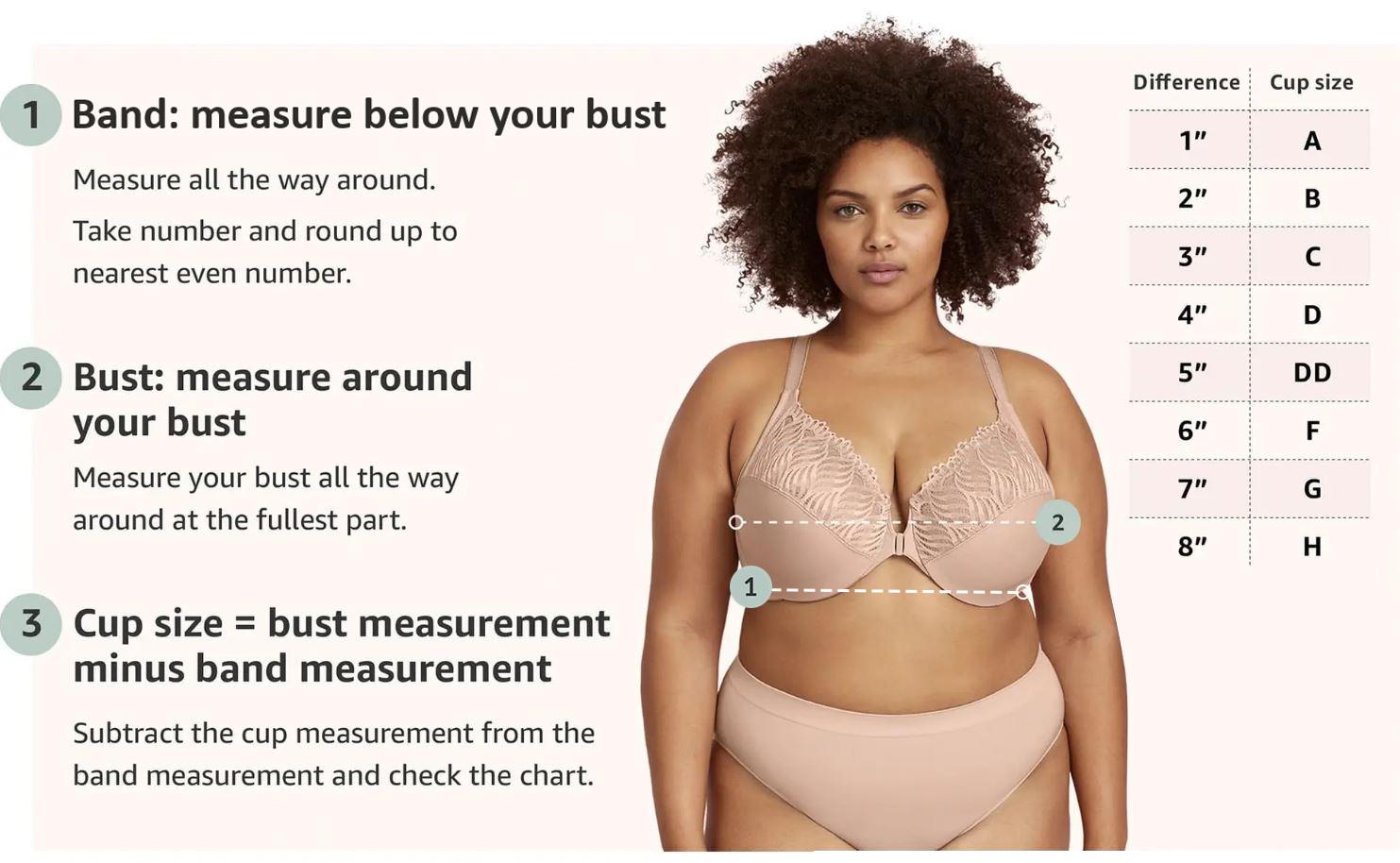
The size on a bra tag is two pieces of information stitched together. The number is your band size, which is the circumference of your ribcage right under the bust. The letter is your cup size, which is the difference between your bust measurement at the fullest point and your band measurement. Every working calculator on the internet uses some version of this. The problem is that older calculators add four or five inches to the underbust measurement to “get to” the band size, and that math came from a 1930s sizing convention that assumed stiff, non-stretch fabric. The +4 rule is the single biggest reason most women are wearing a band two or three sizes too big and a cup two or three sizes too small.
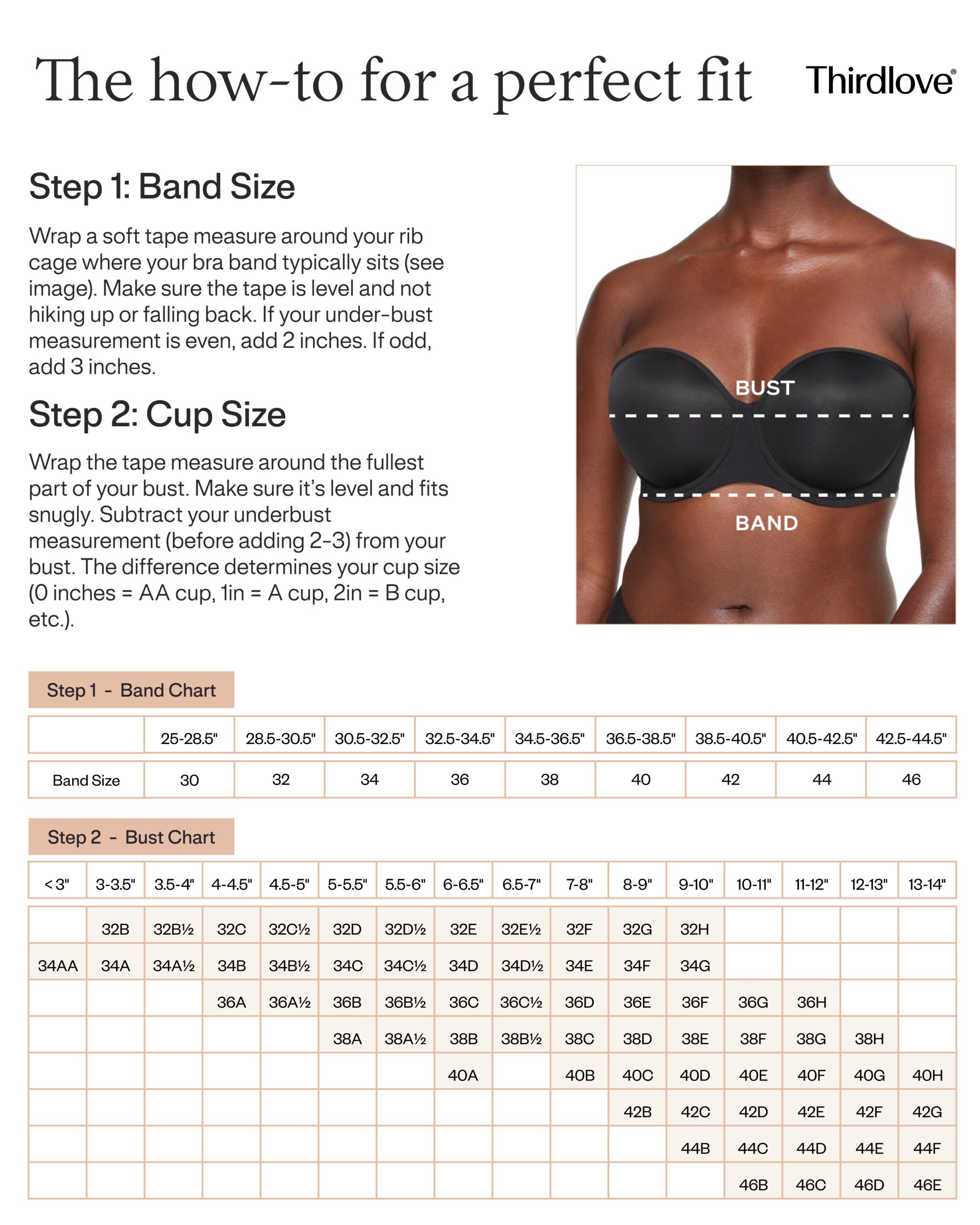
The version that works in 2026: measure your underbust, round to the nearest whole number, and that is your band size. No additions. Then measure your bust at the fullest point, subtract the band number, and use the differential to find your cup. One inch is A, two is B, three is C, four is D, five is DD, six is DDD, seven is G, eight is H, nine is I. The chart continues through K and beyond in specialty brands.
This matters more for plus-size shoppers because the +4 rule produces especially bad results on bigger bodies. If your underbust is 40 inches and you add four, the calculator hands you a 44 band that sits low on the ribs and lets the weight of the bust fall onto the straps. A real 40 band is snug on the first hook, supportive without the straps, and the cups can grow into a 40H or 40I without crossing into specialty territory.
How to take your two measurements without faking the numbers
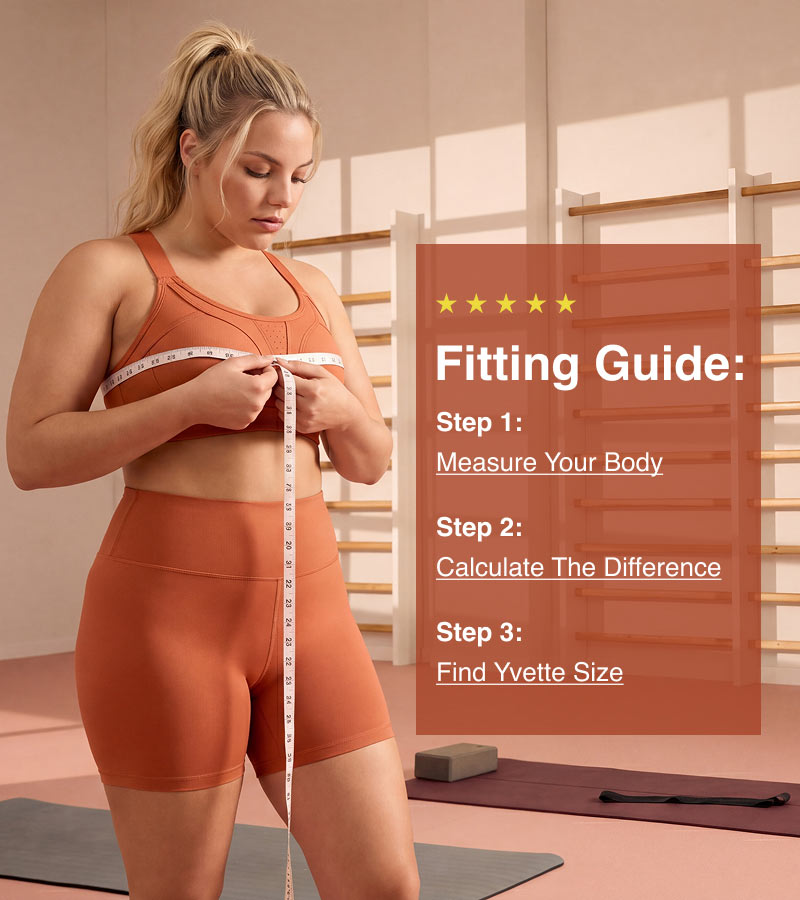
You need a soft cloth measuring tape. The hard contractor’s tape gives you garbage data because it does not curve around a body. A basic sewing tape works and costs under five dollars. Take measurements first thing in the morning before food and water bloat the numbers, while wearing an unpadded, non-push-up bra in roughly the correct band. If you do not own one, take the bust measurement braless. The band measurement does not need a bra.
The underbust measurement is taken directly under the bust where a bra band would sit on your ribcage. Pull the tape level all the way around your back. Keep it parallel to the floor, not slanted up at the back or down at the front. Pull it firm but not tight, the tape should feel like a snug hug, not a corset. Exhale fully before you read the number. Most women hold their breath while measuring, which inflates the rib cage by an inch or more and produces a band size that is too big.
The bust measurement is taken at the fullest point, usually right across the nipple line. Keep the tape parallel to the floor and stand straight without arching forward or hunching back. Wear a thin, lightly-lined T-shirt bra, not a push-up and not nothing. A push-up adds half a cup of false inches. Braless underestimates by a cup on most plus-size chests because the tissue settles toward the band when unsupported. Take both measurements three times and use the middle number, not the smallest. Write them down with the date and recheck every six months.
Finding your true band size, and why the +4 rule is broken
Take your underbust number and round to the nearest even number. Bra bands are sized in even numbers: 32, 34, 36, 38, 40, 42, 44, 46, 48, 50. If your underbust is 37, round up to 38. If it is 41, round up to 42. Some specialty brands carry odd-number bands (Curvy Couture in select styles, Cuup through their app fitting tool), but the vast majority of mainstream and plus-size lingerie is sized even.
The +4 rule came from an era when bra bands were inelastic, and the four extra inches were structural compensation for the lack of stretch. Modern bras have a power-mesh elastic band that stretches three to four inches on its own, so adding four to the underbust measurement makes the band wildly oversized and forces the wearer to fasten on the tightest hook on day one. That is backward. A bra should fasten on the loosest hook when new and migrate inward to the middle and tight hooks as the elastic relaxes over six to twelve months of wear.
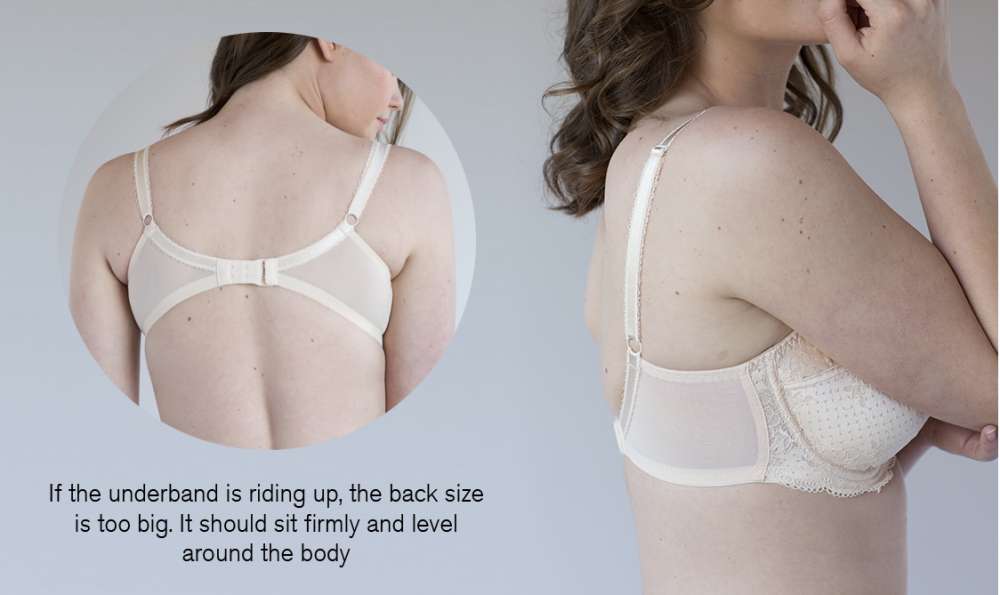
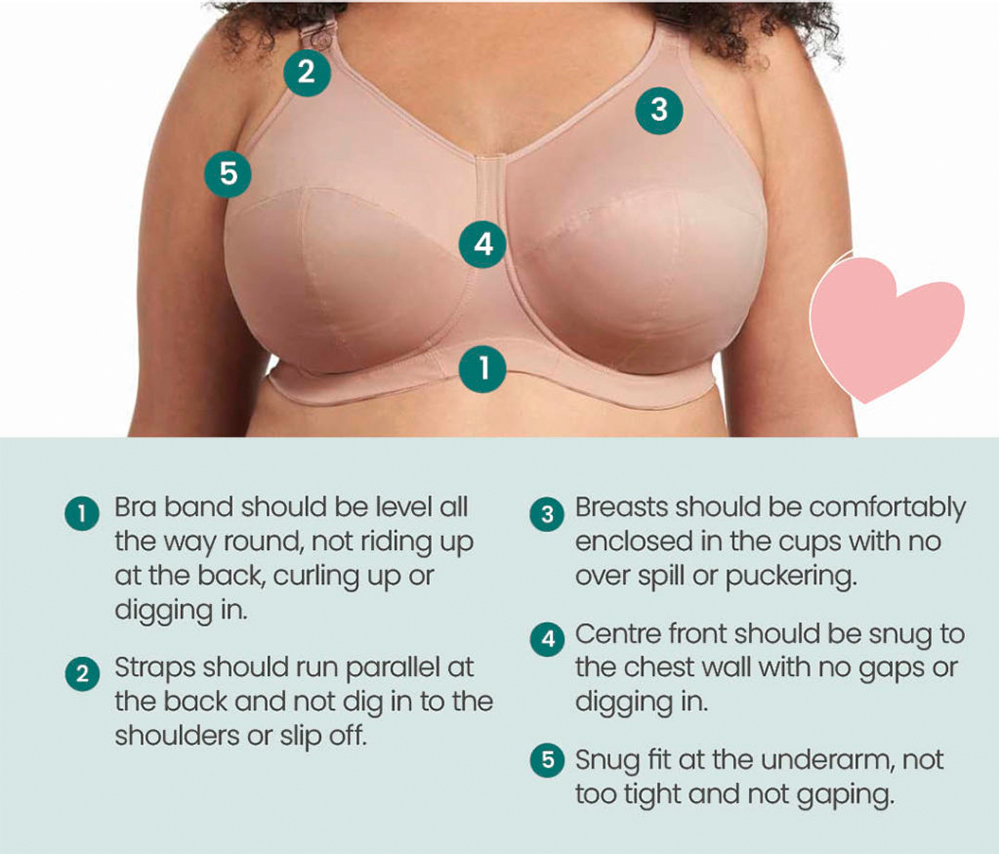
If you have been wearing a 38C for years and the math says your band is a 36, do the test. Try the size up and the size down from the calculator result and judge by feel. The correct band sits flat across your back parallel to the floor, does not ride up when you raise your arms, and supports the weight of the bust without help from the straps. Two fingers should fit under the band, snug, with no real give beyond that. If you can slide four fingers under easily, the band is too big.
Finding your cup size with the bust-band differential
Once your band is locked in, the cup is straightforward subtraction. Take your bust measurement and subtract your band measurement. The differential, in inches, maps directly to a cup letter. One inch is A, two is B, three is C, four is D, five is DD (also written E in UK sizing), six is DDD or F, seven is G, eight is H, nine is I, ten is J, eleven is K, twelve is L. The chart continues to N in specialty brands like Elomi and Curvy Couture.
The cup letter is paired with the band number to make your full size. A four-inch differential on a 36 band is a 36D. A seven-inch differential on a 40 band is a 40G. The cup volume is keyed to the band: a 36D and a 38D are not the same cup volume because the 38D cup is cut wider to fit across a larger band. “I’m a D cup” is a meaningless statement without the band number attached.
Differentials shift slightly between US and UK sizing. UK brands like Bravissimo, Panache, Curvy Kate, Freya, and Elomi use letters that go A, B, C, D, DD, E, F, FF, G, GG, H, HH, J, JJ, K - a doubled-letter pattern that US brands collapse. A US 36G is roughly equivalent to a UK 36F. The fitting calculators at Curvy Couture, ThirdLove, and Bare Necessities convert this when you input your differential. If your differential lands at exactly 4.5 inches, round up. A too-small cup overflows at the top and sides in a way that is uncomfortable and visible under clothing.
Sister sizes - how to swap when the band or cup is wrong
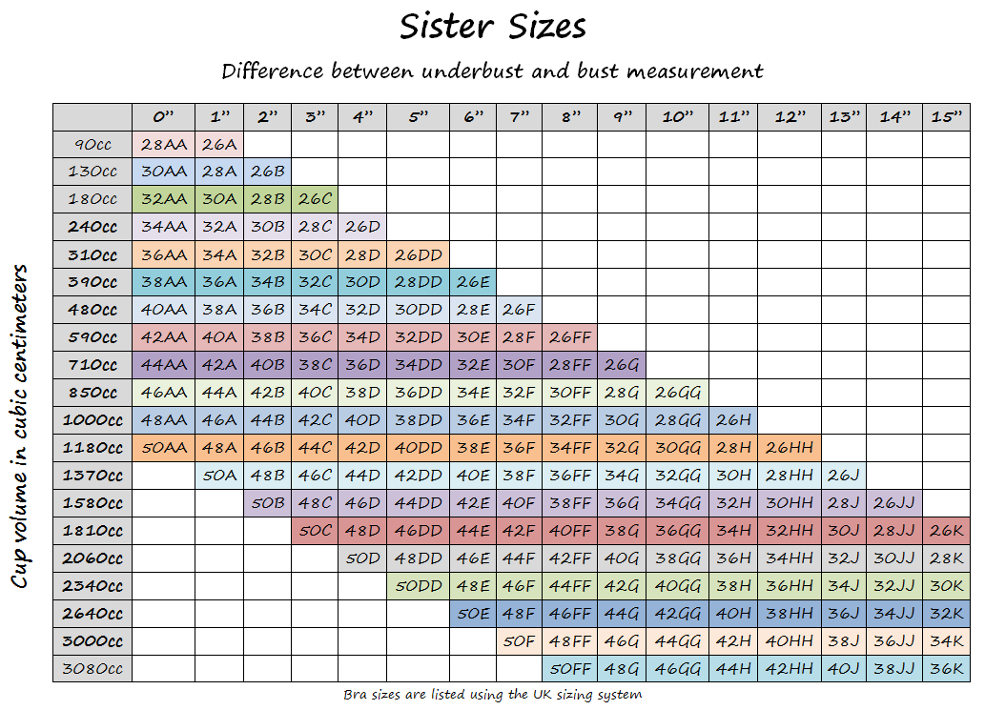
Sister sizes are the most useful piece of bra knowledge most women have never been told. A sister size is a different band-and-cup combination with the same cup volume as your starting size. If your calculator result is a 38D but the 38 band feels too big, you can go down to a 36 band, but the 36D cup is too small for your bust, so you compensate by going up one cup letter to a 36DD. Same volume, different distribution.
The pattern works both ways. If the calculator gives you a 36DD and the band is too tight, go up to a 38 band and down one cup letter to a 38D. Same volume, looser band. This matters because when a specific style only cuts certain sizes, sister-sizing lets you find a version that fits. Some Cuup styles run small in the band and large in the cup. Some Curvy Couture styles run the opposite. Knowing two adjacent sister sizes for your true size doubles the inventory you can actually shop.
The limit is that you cannot move more than one band step in either direction without the cup width feeling off. A 36D and a 38C share cup volume in theory, but the 38C cup is wider and shallower, so the fit on the chest wall changes. If you have to move more than one band, you are in a different size altogether. Retailers that publish a clear sister-size chart on the product page - Bare Necessities through Amazon being the broadest example - are the ones worth shopping if you are between sizes.
Five fitting-room mistakes that mean the size is wrong
The fitting-room mirror catches every bra-size problem in under sixty seconds if you know what to look for. The same five mistakes tell you whether you need a band swap, a cup swap, or a sister-size adjustment.
First, the back-band ride-up. Raise both arms overhead and lower them. If the band has migrated up your back, the band is too big. The band should stay parallel to the floor on the same plane as the underbust. Drop one band size and go up one cup.
Second, the underwire dig or float. The wire should sit flat against your sternum in the center and follow the natural crease where the breast meets the ribcage on the sides. Wire digging into breast tissue at the side means the cup is too small. Wire floating away from the body in the front gore is the same diagnosis.
Third, the cup overflow. A correctly fitted cup encloses the breast smoothly without spillover at the top, side, or bottom. The “quad-boob” look at the top is the classic too-small-cup signal. Spillover at the underarm is the same problem. Go up one cup letter, hold the band where it is, and check again.
Fourth, the gore lift-off. The center gore between the cups should sit flat against your sternum, flush with the body. If it floats forward, the cup is too small for the projection of your bust and the gore is being pushed away. Try a larger cup or a deeper-cup brand. UK brands like Elomi cut deeper cups than most US brands and solve this for many shoppers.
Fifth, the strap dig. If you are constantly adjusting the straps or they leave red marks on your shoulders, the band is doing none of the supportive work. The straps should carry roughly twenty percent of the support; the band the other eighty. Strap pain almost always means the band is too big. Tighter band, larger cup, straps relax.
What you actually need - tape, brands, return windows
The tools list is short. A soft cloth measuring tape from Amazon for under five dollars. A notepad or Notes app entry where you keep your two measurements, your calculator result, and your actual size in each brand. A 38DDD in Curvy Couture might be a 38G in Elomi and a 38DD in Cuup - same volume, different sizing conventions.
For plus-size shoppers, the brands worth knowing first are Curvy Couture (32 to 46, cups A to K, US sizing), Elomi (32 to 46, DD to N, UK sizing with deep cups for full-on-bottom shape), Glamorise (32 to 50, wireless and front-close options), Cuup (30 to 42, A to H, app-based fitting), and Wacoal (32 to 44, A to H, broadly available at Nordstrom). Curvy Couture at Nordstrom is the broadest starting point because Nordstrom takes returns on worn intimates within reason. Cuup and ThirdLove accept first-bra returns even on worn merchandise as part of their fit-guarantee programs.
Frequently asked questions
The calculator says I’m a band size two sizes smaller than I’ve been wearing. Is that right?
Almost certainly yes. The +4 rule has been giving women too-big bands for thirty years. A correct band sits parallel to the floor across the back, does not ride up when you raise your arms, and supports the bust without the straps. If the new calculator size passes those tests, it is right and your old size was wrong. Going from a 40B to a 36DDD feels dramatic on paper but produces the same cup volume in a band that works.
Should I trust the in-app fitting tools at Cuup, ThirdLove, and Aerie?
Cuup’s is the most accurate because it uses the modern math and asks follow-ups about breast shape and projection. ThirdLove’s is decent but conservative on cup size. Aerie’s pushes you toward a smaller cup and larger band because their inventory is concentrated in the 32A through 38DD range. Above a 38D in the calculator, ignore Aerie and shop specialty instead.
I’m between two cup sizes. Which way should I round?
Always round up. A too-small cup overflows and looks wrong under clothing; a slightly-too-big cup wrinkles at the apex but is wearable. The right cup is the smallest size that fully contains the breast without spillover at the top, side, or bottom. At 4.5 inches of differential, round to a DD, not a D.
How often should I remeasure?
Every six months as a baseline, and after any weight shift of ten pounds or more, after pregnancy, after surgery, and any time a bra that used to fit suddenly does not. The remeasure takes five minutes and saves you from buying three bras in the wrong size.
Final word
Most bra-fit problems are not body problems, they are calculator problems and brand problems. Once you know your real underbust, your honest differential, and the brands that cut for that size, you stop buying six bras a year hoping one fits. You buy two or three from brands you have already calibrated against and wear them for two years. Once the math is done honestly, the shopping is easy.