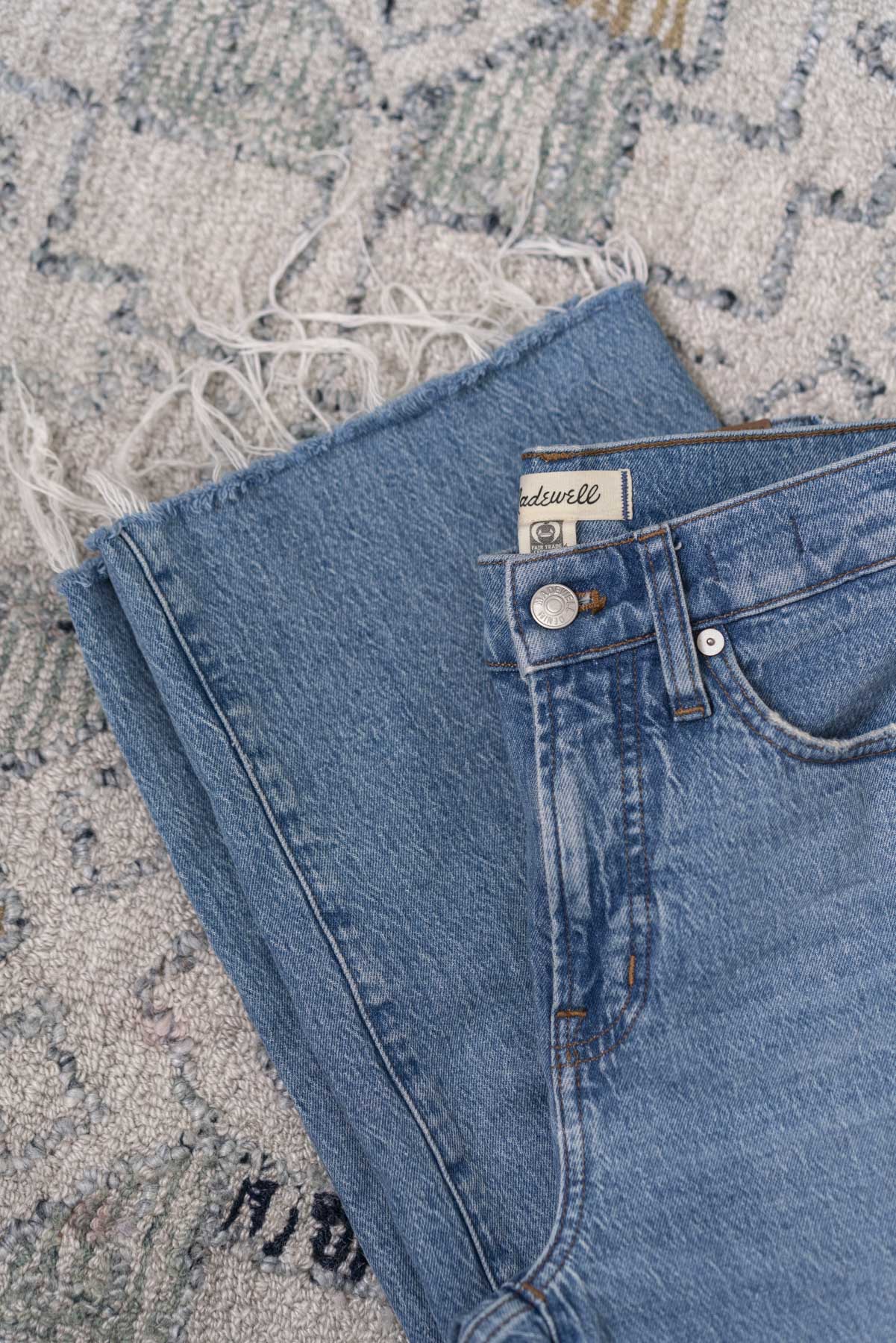
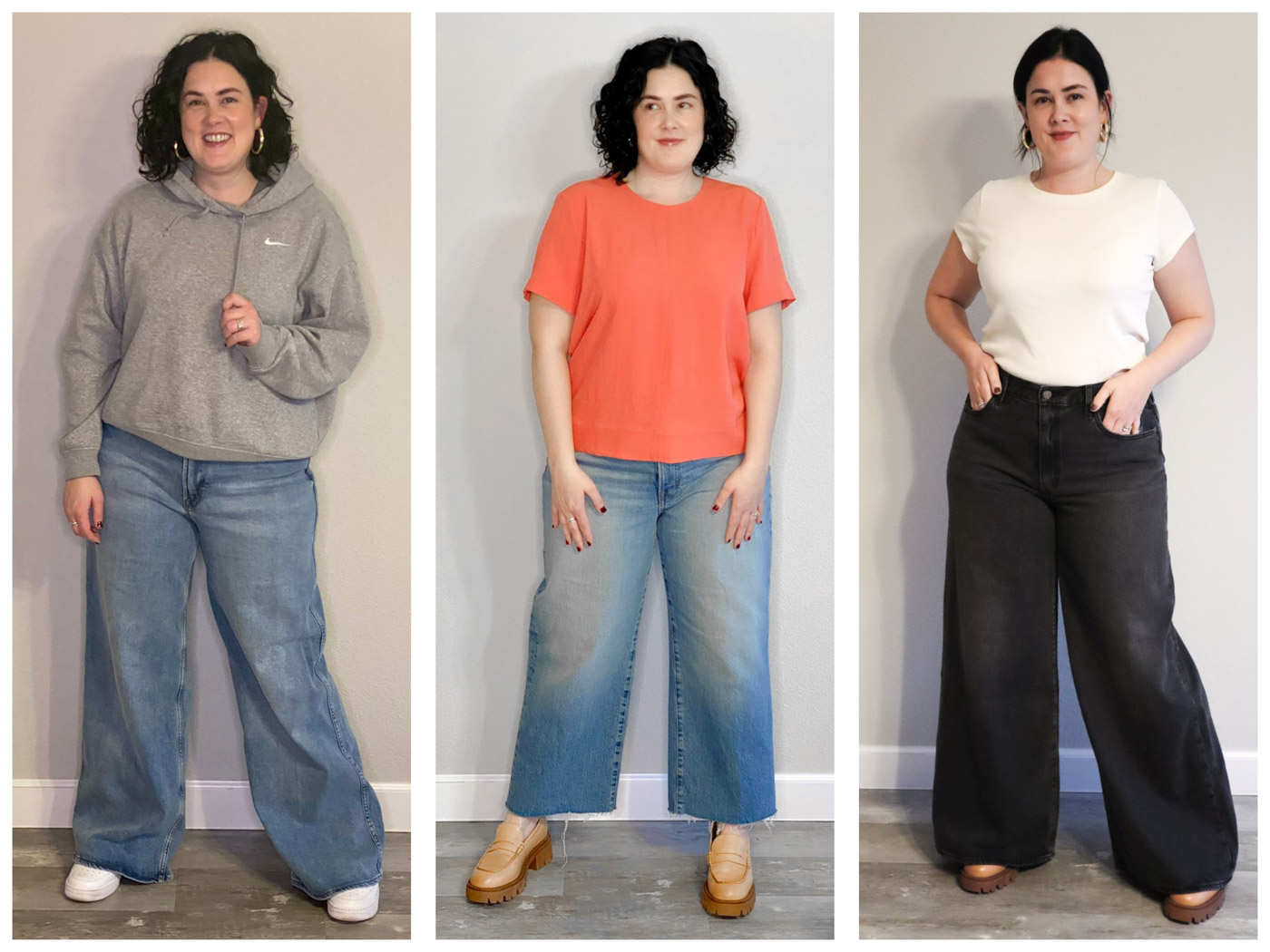
Put Madewell’s own published specifications for the Curvy and the straight-size Perfect Vintage Jean next to each other and the result is genuinely surprising. As of November 2026, Madewell lists both at $128, both in 99% cotton with 1% elastane, and both with an 11 inch rise, a 12 and three quarter inch leg opening and a 29 inch inseam. The numbers are identical. Whatever the Curvy fit does for you, it is not doing it through rise, inseam, leg opening or stretch content. It is doing it through the shape of the pattern, and specifically through the waistband. That is a much more useful thing to know than a vague promise about extra room, because it tells you exactly which fit problem the Curvy line solves and which ones it does not.
This is a specification comparison, not a wear test. Every measurement and price below comes from Madewell’s own product pages and fit guidance, checked in November 2026, and anything that is our reasoning about why a pattern behaves a certain way is labelled as such. If you have been buying the straight-size fit because that is what the homepage surfaces, the question to answer is not which jean is better. It is which pattern matches the relationship between your waist and your hip.
Quick summary
Choose the Curvy fit if your recurring complaint is a gap at the back waist while the hip and thigh fit fine. Madewell describes the Curvy line as redesigned for zero waist gap with more room in the hip and thigh, and on several Curvy styles the brand’s own copy names a contoured band and a longer rise. Choose the straight-size fit if your waist and hip sit closer together and the fit has generally worked. For sizes above the straight range, Curvy and Plus Curvy are the only Madewell options in many styles. The price is the same either way, which removes the usual reason to compromise.
What Madewell says each fit is for
Madewell’s denim guidance splits its jeans into fits rather than sizes, and the Curvy description is specific: a contoured no-gap waistband and extra room through the hips and thighs, with the brand pointing shoppers toward it when the difference between waist and hip measurements is large. The Curvy landing page frames the same thing commercially, describing the line as redesigned for zero waist gap with more room in the hip and thigh across wide-leg, barrel-leg, baggy and straight shapes. Individual Curvy styles go further. The Curvy Perfect Vintage Wide-Leg Jean’s own description references a contoured band and a longer rise, which is Madewell telling you directly that the waistband geometry, not the leg, is the point of difference.
Our reading of that, stated as reasoning rather than as a brand claim: a straight waistband is cut as a near-rectangle, so when it sits on a body where the hip is much wider than the waist, the band has to span a curve it was not shaped for and the surplus shows up as a gap at the centre back. A contoured band is cut on a curve, so it follows that line instead of bridging it. That mechanism also explains the limitation. On a body where waist and hip are closer together, a contoured band has more curve than the body supplies, and the same surplus reappears, just in a different place.
The published specifications, side by side
These are Madewell’s listed figures for three versions of the same style, taken from the brand’s product pages in November 2026. Note how little changes between the first two columns.
| Specification | The Curvy Perfect Vintage Jean | The Perfect Vintage Jean | The Plus Curvy Perfect Vintage Jean |
|---|---|---|---|
| Listed price | $128 | $128 | Listed with the Plus Curvy range |
| Rise | 11 inches | 11 inches | 13 inches, described as high rise |
| Leg opening | 12 and three quarter inches | 12 and three quarter inches | 15 and one quarter inches, tapered |
| Inseam | 29 inches | 29 inches | 27 and one half inches |
| Fabric | 99% cotton, 1% elastane | 99% cotton, 1% elastane | 99% cotton, 1% elastane, Heritage Stretch denim |
| Waistband | Contoured, described by Madewell as no gap | Standard | Fitted through hip and thigh |
| Site rating at time of checking | 4.1 from 29 reviews | 4.2 from 34 reviews | Not captured |
Two things are worth drawing out. The price gap people assume exists between the two fits did not exist at the time of checking, so there is no financial reason to settle for the pattern that fits you worse. And the on-site review counts are small, in the dozens rather than the thousands, so treat those averages as a weak signal rather than a verdict. They are quoted here because they are real and checkable, not because 29 reviews settle anything.
What the Curvy pattern is built to fix
The back waist gap is a geometry problem, not a sizing problem, which is why sizing down has never solved it for anyone. If you size down to close the gap, you tighten the band at the waist and the hip and thigh become too tight at the same time, because a straight-size pattern scales both together. The contoured band breaks that link by removing fabric at the waist without removing it at the hip. That is also why Madewell’s guidance points you to the fit by the difference between your two measurements rather than by your size. Measure your natural waist and the fullest point of your hip, write both numbers down, and let the gap between them choose the line.
The second thing a longer rise does is keep the waistband where you put it. A band that sits below the natural waist has a narrower, more sloped surface to grip, so it migrates downward over a day of sitting. A taller back rise gives the band a wider, flatter area to sit against. Madewell names a longer rise on some Curvy styles and lists a 13 inch rise on the Plus Curvy Perfect Vintage against 11 inches on the standard version, which is the clearest published evidence of that design intent anywhere in the range.
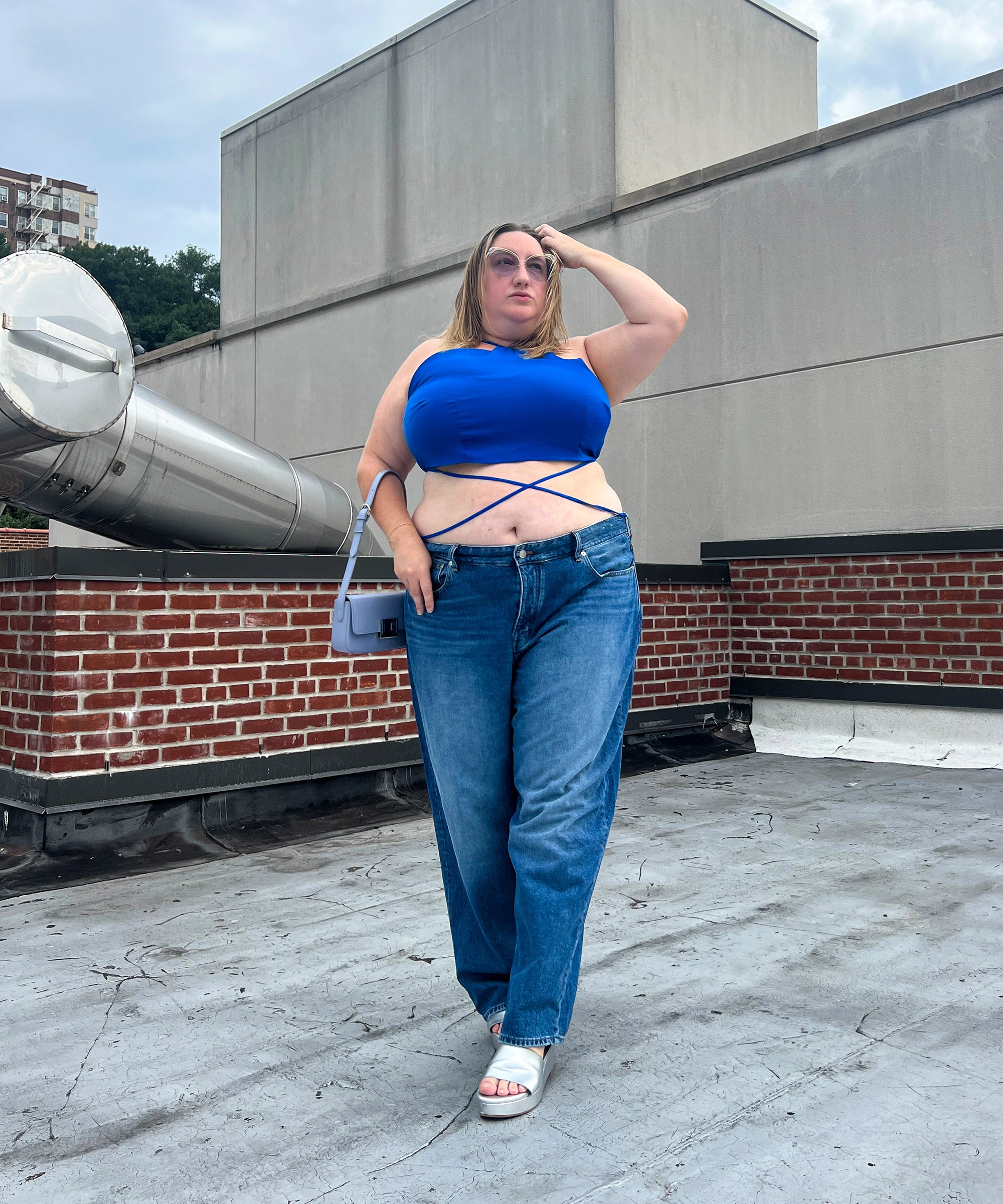
What the Curvy pattern will not fix
Two limitations follow directly from the published specifications. First, the fabric is the same 99% cotton with 1% elastane in both fits, so neither version offers meaningfully more give than the other. One percent elastane is a touch of recovery, not stretch denim, and a rigid fabric transmits a pattern mismatch straight to your skin rather than absorbing it. If you want a denim that forgives a fit difference, you are looking for a high-stretch construction, which is a different product category.
Second, Curvy does not mean roomier everywhere. The published leg opening and inseam are the same as the straight fit, so the Curvy Perfect Vintage is not a wider or longer jean. If your issue is the thigh rather than the waist, a tapered slim style will read as close in either fit, and the useful move is to change silhouette rather than fit line. Madewell publishes the leg opening on every style, so a wide-leg or barrel shape is easy to identify from the spec sheet rather than from the photograph.
Sizes, availability and where the ranges stop
Madewell runs numeric denim sizing plus a separate Plus and Plus Curvy range, and not every style appears in every fit. That is the real limitation of the Curvy line and it is worth checking before you fall in love with a wash: filter by the Curvy or Plus Curvy category first, then choose the wash from whatever remains, rather than the other way around. Styles also carry different inseam options, and because the Curvy and straight versions of the same style can share a published inseam, the length you need is usually a petite, regular or tall question rather than a fit-line question.
Buying through a department store rather than direct is a reasonable hedge when you want to compare two fits at home, because return windows differ by retailer and a side-by-side comparison in your own mirror is the only way to settle a waistband question. The Curvy Perfect Vintage at Nordstrom and the straight-size version at Nordstrom let you order the same wash in both patterns and send back the one that loses. Check the current return terms at whichever retailer you use before you cut tags.

How Madewell compares on published numbers
If Madewell’s rigid 99% cotton construction is the sticking point, two brands are the usual cross-shop and they differ from Madewell on exactly that axis. Universal Standard publishes an unusually wide size range and builds its denim around a plus-size block rather than a graded straight-size one. Good American’s Always Fits denim uses a high-stretch construction designed to work across adjacent sizes, which is the opposite philosophy from a 1% elastane jean. Abercrombie’s Curve Love is the closest direct analogue to Madewell Curvy, and the same advice applies: compare the published waist-to-hip approach rather than the marketing language. Check each brand’s current prices and return terms yourself, because all three move.
Common questions
Is Madewell Curvy a plus-size line?
No. Curvy is a fit, not a size band, and Madewell sells it across numeric sizes as well as in a separate Plus Curvy range. That means a smaller size with a large waist-to-hip difference belongs in Curvy just as much as a larger one does. The fit line is chosen by shape and the size is chosen by measurement, and conflating the two is the most common reason people end up in the wrong pattern.
Do I need to size down in Curvy?
Start at your usual Madewell number. The Curvy pattern redistributes room between waist and hip rather than adding it overall, so the nominal size should hold. If the waist then feels loose while the hip is right, that is a signal to size down one and check again. Because the two fits are listed at the same price, ordering both in one size is a cheaper experiment than ordering one fit in two sizes.
Will these shrink?
Madewell’s care guidance on these styles is to wash cold with like colours, and both fits use the same 99% cotton with 1% elastane. Cotton denim is the part that shrinks with heat and elastane is the part that degrades with it, so a hot wash or a hot dryer risks both a tighter waist and a band that no longer recovers. Wash cold and air dry and you avoid the question entirely. The risk is identical across both fits because the fabric is identical.
Can a tailor fix a waist gap on the straight-size fit instead?
Often, yes. Taking in the centre back seam is one of the most routine denim alterations there is, and on a jean with a simple waistband and a back yoke it is usually straightforward. The limits are how much can be removed before the back pockets look crowded and whether the yoke seam lines up afterwards. If the gap is small, alteration is a reasonable route. If it is large, you are asking a tailor to rebuild the geometry that the Curvy pattern already provides.
How to settle the Curvy question in one order
Measure your natural waist and the fullest part of your hip and write both numbers down. Order the same wash and the same numeric size in both the Curvy and the straight-size Perfect Vintage, since Madewell listed both at $128 at the time of checking. Put each on, sit down for a full minute, then stand and look at the centre back in a mirror. Whichever band stays flat through that sequence is your pattern, and that single test tells you more than any review count on either product page. Then buy the rest of your denim in that fit line and stop re-litigating it. Madewell Curvy denim is also stocked on Amazon if you want a second retailer to compare stock and terms, and our wider plus-size denim coverage goes further on silhouette.