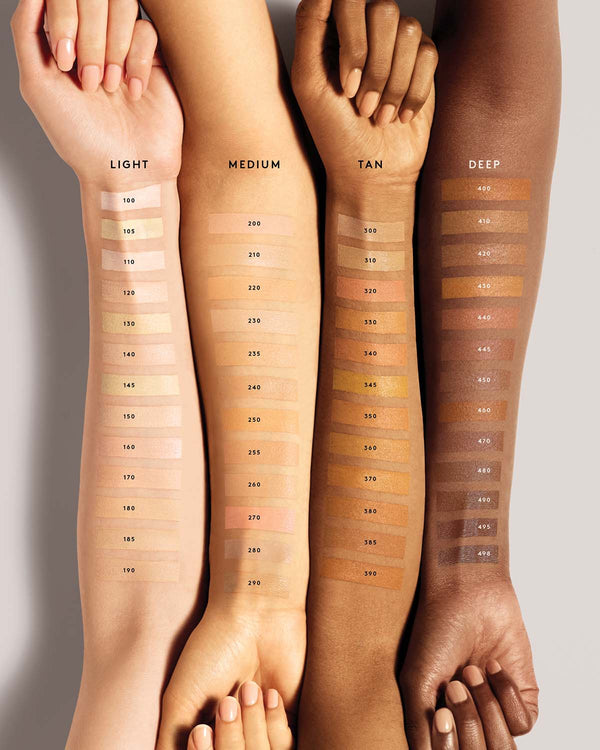
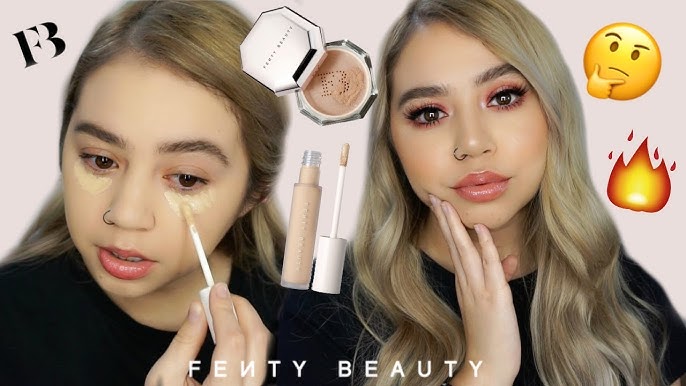
The brand that gets credit for the most inclusive shade range in the industry is, on my face, the third-best concealer I keep on my vanity. Fenty Beauty’s Pro Filt’r Soft Matte Concealer launched in 2018 with 50 shades and changed the public conversation about how brands underserve deep complexions. The launch was a moment. The product is also a product, and after using shade 410 across two full tubes over fourteen months, I can tell you where it shines, where it doesn’t, and which two alternatives I reach for first when I’m doing a paying client. The shade range is real. The formula is a separate conversation.
Context on the face this review is written from: I’m NC45 in MAC’s range, which translates roughly to Fenty 380 to 410 depending on where my undertone falls. I’m neutral-warm with golden undertones - not olive, not pink-based. Biracial Black and Filipina, normal-leaning-dry through the cheeks, oily through the T-zone, with hereditary blue-purple undereye circles that need both color-correcting and coverage. I trained at MAC Pro in LA at 19 and did pro makeup commercially for four years before I started writing. This concealer is good. It is not the best one I own.
Quick verdict
Rating: 3.5 out of 5. Genuinely impressive shade range with 50 options that account for actual undertone variation, not just lightness. Formula is buildable, soft-matte, and forgiving on textured skin. Loses points for oxidation by hour four on warmer undertones, dryness around the eye area on anyone over 30, and a price that creeps above what the formula justifies. Best for: medium-deep to deep skin tones doing a daytime full-face look under three hours. Skip if: you have mature or dry undereye skin, or if you need transfer-proof wear past six hours. Where to buy: Fenty Pro Filt’r Soft Matte Concealer at Sephora , $30 for 0.27 oz.
What it is and the brand context
Fenty Beauty launched in September 2017 with Pro Filt’r Soft Matte Longwear Foundation in 40 shades. The concealer followed in early 2018 with 50. Both products were formulated around the idea that shade matching for deep complexions had been treated as an afterthought for the previous thirty years of mass-market cosmetics. The concealer specifically was the first major drugstore-adjacent launch I can remember where deep shades had distinct neutral, warm, and cool variants instead of one generic “dark” bucket. The 400-range alone has nine shades. That’s more deep-tone options than most luxury brands carry across their entire complexion line.
The formula is positioned as a medium-to-full coverage liquid concealer with a soft-matte finish, marketed as 16-hour wear and crease-resistant. The brand has reformulated quietly twice since launch, both times tightening the pigment load and adjusting the dry-down time. The version that ships in 2026 is not the version that shipped in 2018. If your last impression of this product was from the original launch, it’s worth reassessing.
My experience across fourteen months
I picked up my first tube in shade 410 in March 2025 after a client booking where my regular concealer ran out mid-job. I bought Fenty as the backup, used it on the client (medium-deep neutral-warm, close to my own depth), then kept using it on myself for the next eight months. Second tube went into rotation in November. So this review is anchored in two complete tubes of regular wear, not a one-week trial.
What 410 looks like on my face: cool morning light, freshly applied, it matches almost perfectly. The pigment leans neutral with a touch of warmth, which is what my undertone needs to brighten the undereye without going gray. The dry-down takes about 90 seconds, generous compared to MAC Studio Finish (60 seconds) but workable. Once set with a translucent powder, it doesn’t move for about three hours. By hour four, I can see it shift warmer. By hour six, on my T-zone where I run oily, it has migrated into my smile lines. I’m 28, so this isn’t about deep texture - the formula just doesn’t have the staying power for a workday.
On clients, I’ve used 380 and 410 on five different medium-deep faces, mostly for event makeup that needs to last four to six hours. It performs well on normal-to-combination skin. One client who runs very oily, it broke down at the chin by hour five. Another with hereditary darkness similar to mine, the coverage was clean at application but I had to set it heavier than usual to keep it from creasing into her inner corner by hour three. The lesson: this is a great mid-day concealer that wants to be a longwear concealer and isn’t quite there.
The applicator is the unsung problem. The doe-foot is too wide for precise under-eye work and picks up too much product per dip. I dispense onto the back of my hand and apply with a small synthetic brush, which solves the precision issue but adds a step the packaging should have solved at the formulation stage. For a $30 concealer, the wand should be the right size.
What works
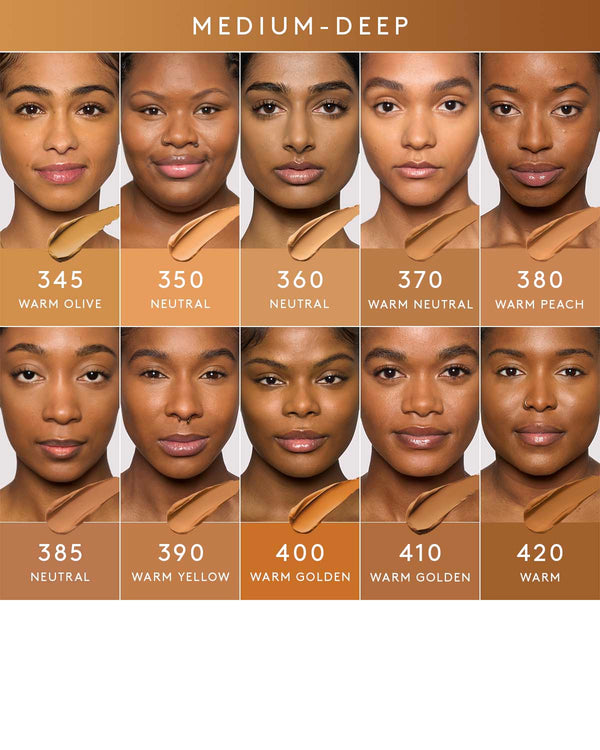
The shade range remains genuinely the best in the industry for deep complexions, and the math behind it is what matters. Most brands launch with one or two “deep” shades that try to cover everyone from medium-deep to deepest. Fenty’s deep range distinguishes between warm-leaning, neutral, and cool-leaning at each depth level. For me at 410, the alternative would be Pat McGrath Skin Fetish Sublime Perfection in MD37 or MAC Studio Finish in NW45. Both work, but 410 is a tighter undertone match than either. That’s not nothing for anyone who has spent years mixing two concealers to fake a shade that should have existed.
The coverage is genuinely buildable. One pass gives you a medium veil that evens out the undereye without looking like you’re wearing makeup. Two passes covers a brown spot or a darker discoloration. Three passes is too much for under-eye work but works for blemish coverage if you’re spot-treating. The formula doesn’t pill when layered, which is rare for a soft-matte product at this price.
The dry-down behaves predictably on textured skin. I have a few small bumps near my hairline that other matte concealers settle into and emphasize. Fenty’s formula sets without doing that, which I credit to the slightly slower drying time. You have a window to blend it properly before it locks.
The pigment load is honest. Some concealers swatch accurately and then sheer out to nothing on the face. This one delivers the shade you bought, which sounds like a low bar until you’ve spent $40 on a tube of something that vanished under powder.
What doesn’t work, honestly
Oxidation is the headline problem. On my warm undertone, 410 shifts about half a shade warmer between hour three and hour five. It’s not catastrophic - I’m not orange by the end of the day - but I notice it in photos and I notice it under bathroom lighting. For warmer-undertone medium-deep skin, this is the single biggest reason to consider a different formula. Cool-undertone wearers I’ve worked on don’t seem to see the same shift, which makes me think the oxidation is reacting with the warm pigment load specifically.
The dryness around the eye area is the second issue, and this one gets worse the older you are. At 28, I’m fine through the lid and the inner corner, but my outer corner does dry down to a flat finish that needs hydration underneath to look comfortable. I’ve watched it look noticeably parched on two clients in their late 30s and early 40s, both of whom had no dryness issues with NARS Radiant Creamy on the same day. If you’re past 30 with any natural dryness around the eyes, this formula is going to fight you.
The price has crept up. The concealer launched at $26 and is now $30. That’s not a huge jump on paper, but the formula hasn’t improved in a way that justifies it. Compared to drugstore alternatives that have closed the gap on shade range, the value proposition is narrower than it was in 2018. You’re paying for the brand, the shade match, and the soft-matte finish. You’re not paying for technology that drugstore brands can’t access.
The packaging matters when you’re working professionally. The matte plastic tube scratches easily, and the labeling on the bottom (where the shade number lives) wears off after about three months of bag-rattling. By the end of the first tube, I had to remember 410 from muscle memory because the print had rubbed off. Not a deal-breaker. Annoying for $30.
How it compares to alternatives
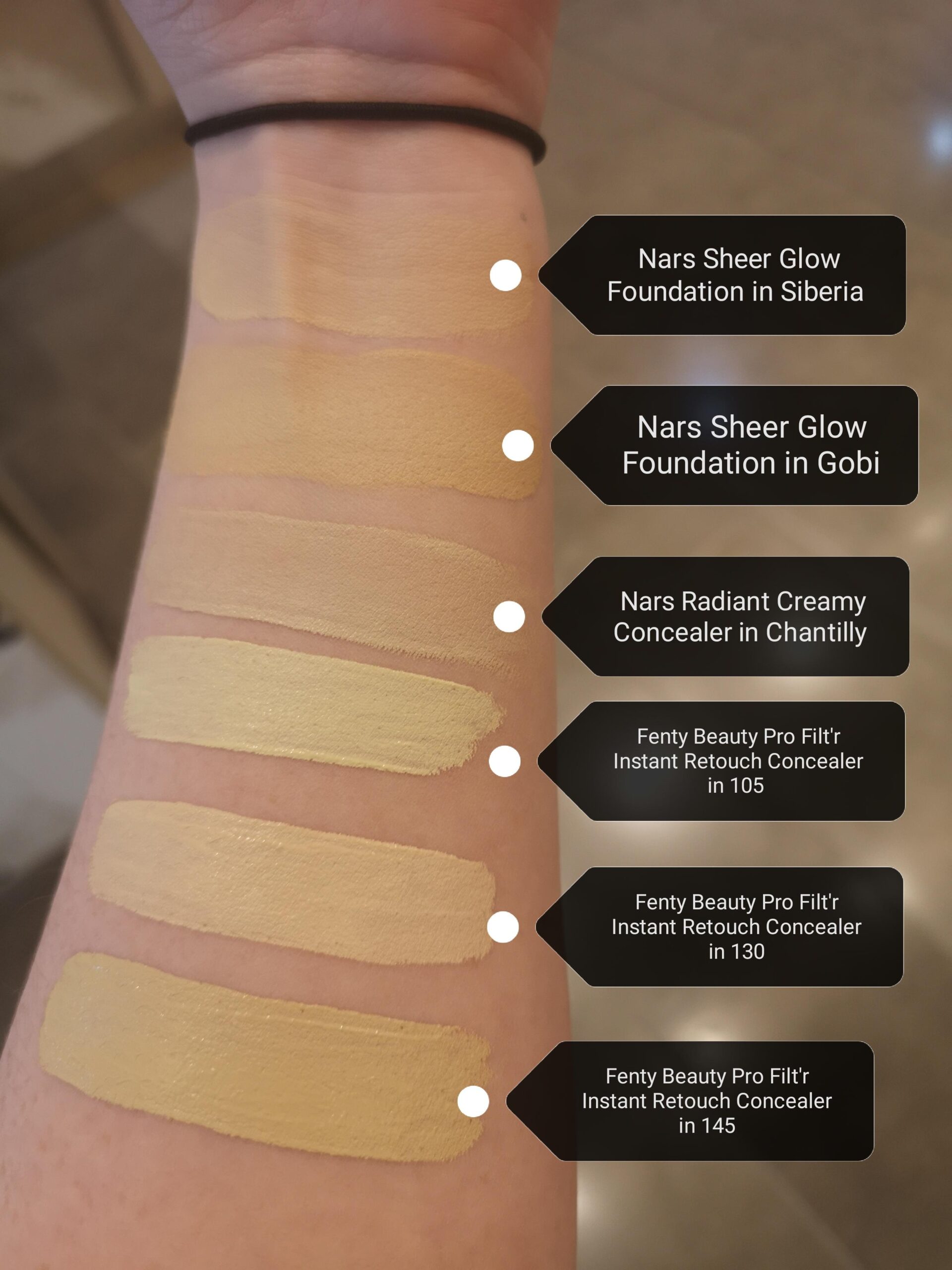
I keep three concealers in my deep-shade rotation. Honest comparison of each against Fenty:
NARS Radiant Creamy Concealer in Cafe or Cacao - $32 for 0.22 oz. The reason this one stays in my kit for client work is the finish. NARS reads as natural radiant skin where Fenty reads as set makeup. For mature skin, dry skin, or any look that needs to photograph soft, NARS wins. The shade range is shallower at the deepest end (30 shades vs 50) and Cacao is slightly too neutral-cool for me, so I warm it with a drop of foundation. Fenty 410 matches without mixing. But for any client over 35, I reach for NARS first.
Maybelline Instant Age Rewind Eraser in Cocoa or Espresso - around $10 at most drugstores. The honest drugstore answer. The shade range is narrower (about 18 shades vs 50, with limited undertone variation), but the formula on medium-deep skin holds up better than the price suggests. The brightening effect is real. The depth ceiling stops around a Fenty 420 equivalent, so anyone deeper than medium-deep is out of luck. If you can use it, Instant Age Rewind delivers about 80% of what Fenty does for one-third the price. Real value gap.
Pat McGrath Skin Fetish Sublime Perfection Concealer in MD30 or MD37 - $32 for 0.16 oz. Premium-tier alternative with the best dry-down of the three. Pigment payoff is dense without looking cakey. Fewer distinct undertone variants than Fenty in the deep range. For event makeup, photography, or any high-coverage moment, this is what I reach for. For everyday wear, the price-per-ounce ($200/oz vs Fenty’s $111/oz) is hard to justify unless you’re using it professionally.
The pattern across my rotation: Fenty’s strength is shade matching for daytime wear on medium-deep complexions. The competitors win on specific use cases - NARS for radiance, Maybelline for value, Pat McGrath for longwear performance.
Who should buy it and who shouldn’t
Buy if you’re medium-deep to deep with a warm-neutral or true-neutral undertone that has historically been hard to shade-match. Buy if your concealer needs are daytime - work, errands, brunch - and you don’t need it to last past hour five. Buy if you have normal-to-combination skin under 35 and you don’t have significant dryness around the eye area. Buy if you’re a makeup artist building a kit and you need a versatile mid-range concealer that covers the 400-shade range well.
Skip if you’re over 35 with mature or dry undereye skin - the soft-matte finish will fight you, and NARS Radiant Creamy is the better answer for the same price. Skip if you have a strongly warm undertone that pulls orange easily - the oxidation will be noticeable by mid-afternoon. Skip if you need longwear past six hours for events or weddings - reach for Pat McGrath instead. Skip if you’re shade matching at the lighter end of the spectrum, where the formula’s strengths don’t show up as clearly and other brands have caught up on inclusivity.
Where to buy and current pricing
Fenty Beauty Pro Filt’r Soft Matte Concealer is $30 for the 0.27-oz tube at most major beauty retailers. Stock the full 50-shade range at Sephora (Beauty Insider members get 10-15% off during seasonal Beauty Insider sale events, plus a 60-day return policy if the shade doesn’t match), at Ulta (frequent bundle deals with Pro Filt’r foundation), and Amazon if you already know your shade and want fast shipping. Sephora is the safest first-purchase option because of the 60-day return window and the in-store shade-matching - if you’re between two shades, go to a Sephora and test on your jawline before committing.
Frequently asked questions
Does Fenty concealer oxidize?
On warm undertones, yes, by about half a shade between hour three and hour five. On cool and neutral undertones, the shift is minimal or absent. If you’ve found that Fenty foundation oxidizes on you, the concealer will likely do the same, and you should size down a half-shade at purchase to account for it.
Is Fenty concealer good for mature skin?
Not the strongest option. The soft-matte finish accentuates fine lines and dry texture around the eye area, especially after hour four. For mature skin, NARS Radiant Creamy or a hydrating formula like Charlotte Tilbury Magic Away will perform better. Fenty works on mature skin if you prep the undereye with a heavy hydrator first, but it requires more work than a luminous formula does.
What’s the difference between Fenty’s foundation shades and concealer shades?
They use the same numbering system, but the concealer is meant to be applied a half-shade to full shade lighter than your foundation for brightening. If you wear Pro Filt’r foundation in 410, your concealer should be 380 for a brightened undereye effect or 410 for spot coverage that matches the rest of your face.
Is it worth the $30 price tag?
For the shade match on medium-deep complexions, yes. For the formula performance compared to drugstore competitors that have closed the inclusivity gap, the value is narrower. Maybelline Instant Age Rewind gets you 80% of the performance for one-third the price if your shade exists in the line. Fenty earns its premium when the shade range is the deciding factor.
Final verdict
Worth it for daytime wear on medium-deep complexions that have historically been hard to shade-match, with the caveat that you should save your money on Fenty if you’re over 35 with dryness, and spend it on NARS Radiant Creamy or Pat McGrath Sublime Perfection instead. The shade range is the reason to buy this concealer and the formula is the reason it doesn’t sit at the top of my kit. Buy one tube of Pro Filt’r Soft Matte Concealer at Sephora in your closest shade, give it two weeks of daytime wear, and you’ll know within the first week whether the oxidation and dry-down work for your skin. Layering order if you commit: hydrating eye cream first, color corrector under the inner corner if you need it, Fenty concealer applied with a small synthetic brush instead of the doe-foot, set with translucent powder pressed not swept. That’s the protocol that gets the most out of the formula.