On a Tuesday afternoon in early March 2026, I stood in my Brooklyn studio with five hangers lined along the steam pipe and a stack of saved Instagram screenshots taped to the wall. The reference was the quiet-luxury tonal beige column that has been working its way out of editorial captions and into the For You Page for two years now - bone slip skirt, oat cashmere shell, sand silk overshirt, all within a six-shade range of beige, hipbone to clavicle one unbroken column. The pattern has crystallized through a handful of celebrity carousels, a wave of TikTok creator breakdowns, and a comments section that keeps repeating the same phrase: a tonal column is universally flattering. By the time my five fit models walked into the studio, the trend had a name, a shape, and a body-shaped assumption tucked underneath it that nobody on the FYP was naming out loud.
The assumption was this: that a tonal column reads as elongating and elegant on every body. That was the line in the captions, and the comments under Mikayla’s video said it back to her. Looking at my five hangers and my five very different fit models, it was marketing copy. Not garment reality. What I wanted to find out, with Naia and Hannah and Reni and Devyn and Marquita over the next eight days, was what the actual cut does when the body changes underneath it - where the side seam falls, where the dart lands, where the rise hits, and whether the column reads as a column or as five fighting pieces.
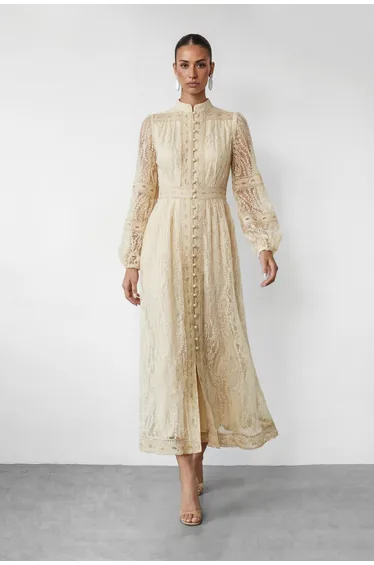
The viral trend and the body-shaped assumption underneath it
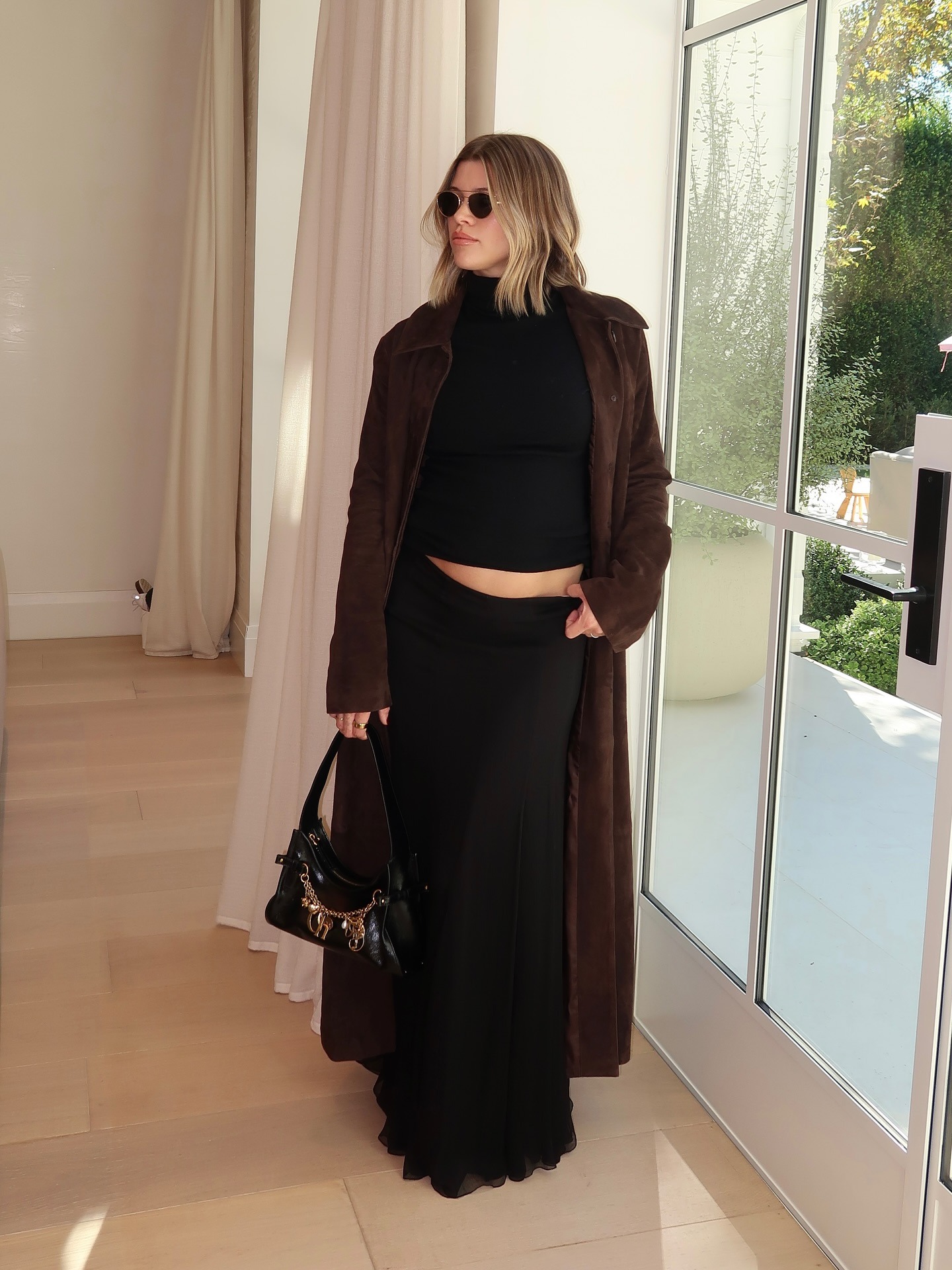
The quiet luxury tonal column did not start with one celebrity. It started, depending on whose runway notes you trust, with The Row’s pre-fall lookbooks and got a second wind through Khaite’s resort campaigns. The translation into clothes a non-stylist could name and buy followed: a slip skirt, a fine-gauge shell, an overshirt, all bone-to-sand, no contrast, no waist break, no print. The civilian vocabulary that took it to the For You Page came from creators who broke down the silhouette piece by piece.
The useful frame, the one nobody puts in a TikTok caption, is this. The tonal column is a silhouette before it is a color story, and the silhouette is a slim rectangle. That is the actual brief. The slim rectangle reads differently on a size 4 frame, where the rectangle is the body, than on a curved body, where the rectangle has to be built out of garments that hold their own shape independently of the wearer. That distinction is the part that does not make it into the trend captions.
The five women in the studio were chosen by size and by willingness to be photographed and to talk on the record. I will use first names. What you are reading is the public version.
Size 10 (Naia, in Lagos): the original-photo version
Naia is a 5’7″ architect based in Lagos, US 10, 34-inch bust, 28-inch waist, 39-inch hip. She came in on day one with a bone slip skirt from Anthropologie’s straight-size range ($148, viscose-silk blend, true bias cut, 30-inch length), a fine-gauge cashmere shell in oat from Quince ($69, size M), and a sand silk-cotton overshirt from Madewell in size 10 ($168).
What worked: almost everything, which is the whole problem with how the trend gets photographed. The bias-cut slip skirt skimmed her hip without pull lines because there were no curve transitions for the bias to fight against. The shell sat flat under the overshirt with no bust strain on the front placket. The shoulder seam landed at her actual shoulder point. The tonal range read as a column from the front because there was no waist indentation breaking the visual line in the first place.
What failed: nothing structural. What failed conceptually was the implicit promise the trend made to the For You Page. Naia’s column worked because the body underneath it was already a slim rectangle. The clothes were not doing the elongating work; the proportions were doing it, and the clothes were getting the credit. This is the version of the trend that goes viral, and it is the version that does the most damage to everyone shopping it at a different body shape, because it sells the garment as the cause of the effect.
Size 14 (Hannah, in Toronto): the closest fit
Hannah is a 5’5″ PR director in Toronto, US 14, 38-inch bust, 32-inch waist, 43-inch hip. She tried a modified Naia stack: the Anthropologie bone slip skirt at the top of the straight-size range (14), the Quince oat shell in L, and a sand silk-cotton overshirt from Anthropologie Plus in 14W ($178, near-identical cut to the Madewell straight-size version but with a longer back hem and a re-graded shoulder seam).
What worked: the Anthropologie Plus overshirt. The brand re-grades its plus block at the shoulder rather than just scaling the straight-size pattern up, which means the shoulder seam landed within a quarter inch of her actual shoulder point instead of dropping two inches down her upper arm. The back hem hit one inch below her hip, giving the column its top section without breaking line. The Quince shell in L sat clean across her bust with no strain at the front placket or side seam.
What failed: the slip skirt. The Anthropologie straight-size grade tops out at 14 and grades the bias cut by adding fabric at the side seam without re-cutting the bias panel. The result was a pull line that ran from her left high hip across the front of the thigh on every step. The fix was to swap in an Eloquii bias-cut midi in bone ($120, size 14, 31-inch length, cut on a true bias panel graded across the plus range from 14 to 28 instead of bolted onto the end of a straight-size pattern). The pull line disappeared. The column reconstituted itself.
Hannah, on the record: “The trend works at my size. The straight-size brands that pretend their pattern goes to a 14 do not.”
Size 18 (Reni, in Atlanta): where the cut starts to argue back
Reni is a 5’8″ nurse practitioner in Atlanta, US 18, 42-inch bust, 36-inch waist, 48-inch hip. By size 18, the column-as-rectangle assumption stops being a styling preference and becomes a construction problem. The brief has to be re-cut, not re-graded.
Reni tried a Universal Standard tonal stack first: a princess-seamed midi skirt in bone, the Tee Rex tee in oat, and an oversized button-down in sand, all from the brand’s current rotation. Universal Standard cuts every garment on the same body block from XS to 4XL, so the proportions hold across the range instead of stretching at the upper sizes.
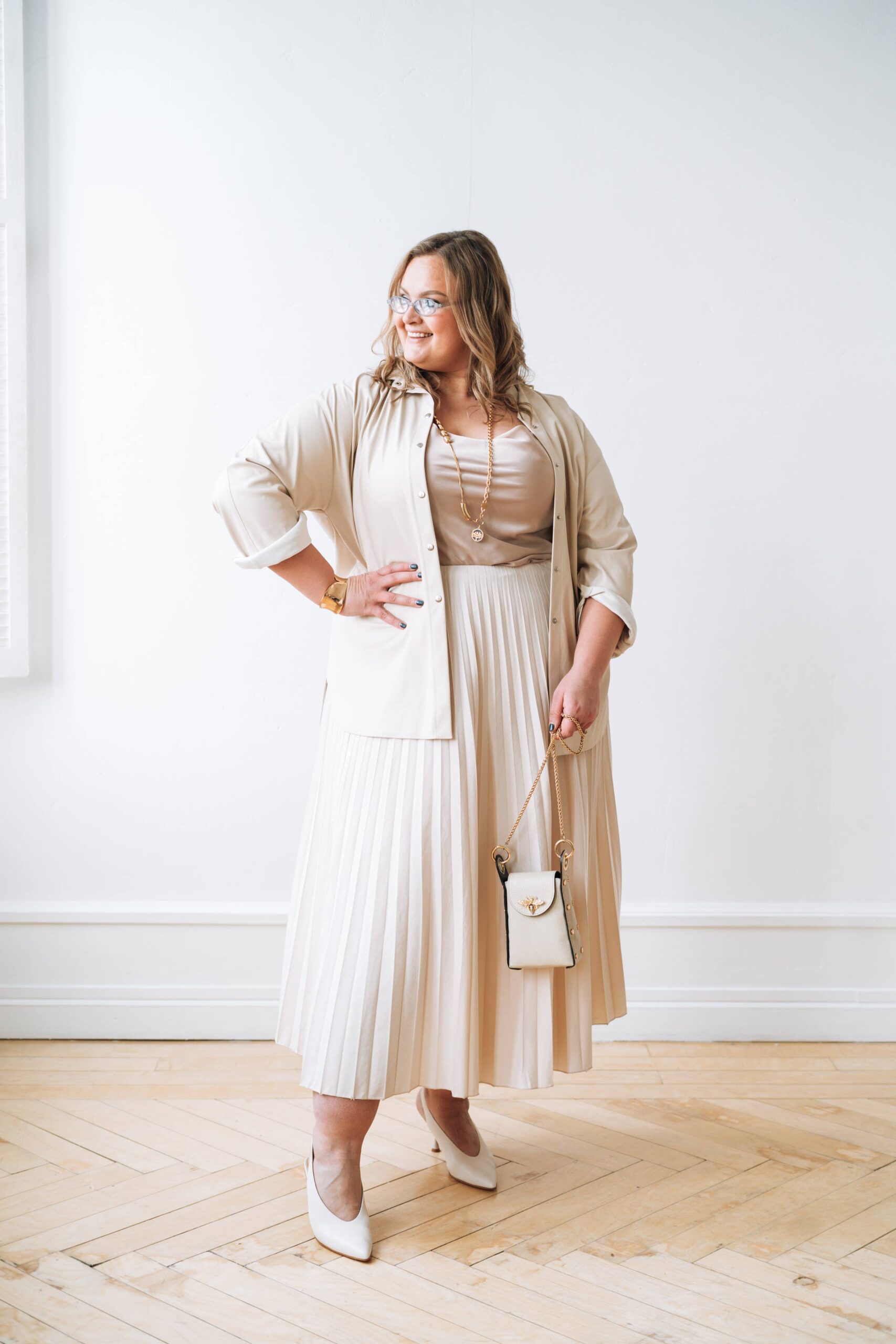
What worked: the princess seaming on the Geneva. A princess seam runs from the armhole down through the bust and into the waist, which lets the pattern carve curve into the garment instead of relying on the wearer to provide it. On Reni’s frame, the seam pulled the column in slightly at the natural waist without breaking the tonal line. The Carter overshirt in size 18 dropped to mid-thigh and gave the stack its top section. The whole column read as a column from ten feet back.
What failed: the Tee Rex shell in the oat colorway specifically. The cotton-modal blend at this dye lot was thin enough that the underbust of Reni’s bra ghosted through the front. Solvable with a different colorway, but worth naming because the For You Page version of this trend assumes the shell layer is invisible underneath the overshirt, and at size 18 with a structured bra the shell becomes load-bearing on its own.
The other thing that argued back was the slip-skirt rise. The Geneva sits at a 12-inch front rise and a 14-inch back rise. At size 18 with a 48-inch hip, the back rise was a half-inch too short, which meant the waistband rolled forward when Reni sat down. Her solution on day three was to size up to a 20 in the skirt and take it in a half inch at the side seam. A 20 graded down beats an 18 stretched up at this body, and that is a pattern I have seen repeated across plus brands for ten years.
Size 22 (Devyn, in Houston): the structural rebuild
Devyn is a 5’6″ college instructor in Houston, US 22, 46-inch bust, 40-inch waist, 52-inch hip. At size 22, the trend stops being something you participate in by buying the trend’s exact pieces. It becomes a silhouette you reconstruct from the ground up using garments built on a plus block.
The Universal Standard stack that worked on Reni did not hold for Devyn at the same pattern. The Carter overshirt in 22 had a sleeve that read proportionally too short for her arm length, and the Geneva slip skirt’s princess seam was hitting at a waist point the shell underneath could not cover smoothly. Devyn rebuilt the column from Marina Rinaldi and Eloquii pieces instead.
Marina Rinaldi is the Italian plus label owned by the Max Mara group, with its younger Persona by Marina Rinaldi line carrying the same construction logic at a lower price tier. A heavier silk-blend trouser in bone replaced the slip skirt entirely. The brand cuts its plus pattern from the original Max Mara editorial block, then re-engineers it for a plus body rather than grading up. The front-waist dart placement is shifted closer to center front, which gives the trouser a flat front instead of a strained front at the high-hip curve. The fabric weight (heavier than most US plus brands stock) holds its own line independent of the body underneath. The column is not the body. The column is the garment.
Over the trouser, Devyn wore an Eloquii oversized boyfriend-style shirt in sand. Under both, an Eloquii fine-gauge knit shell in oat sat clean. The column held.
What failed: any version of this in the Anthropologie Plus or Old Navy Plus range at size 22. The Anthropologie Plus overshirt that worked on Hannah at 14 stops being re-graded above 20W and just gets scaled up: the shoulder seam drops two inches, the back hem flares, the column line breaks. Devyn tried four Old Navy Plus pieces in the lead-up. None held the column line longer than the photograph it took to document them.
Devyn, day five: “The trend is not the problem. The pattern grading at mid-tier prices above size 20 is the problem. The pieces that work cost three times what the For You Page tells you the look costs.”
Size 26 (Marquita, in Brooklyn): the alternate-route version
Marquita is a 5’4″ middle school principal in Brooklyn, US 26, 52-inch bust, 46-inch waist, 58-inch hip. By size 26, two things change at once: the pool of brands that cut a true 26 narrows to roughly seven labels in the US market, and the column silhouette, executed as a literal slim rectangle, fights the body it sits on harder than it needs to. The alternate-route version is what gets the tonal-column effect without forcing the rectangle.
Marquita’s first attempt was a literal column: Universal Standard’s Geneva slip in bone at size 26 plus the Carter overshirt at 26. The slip skirt worked on its own. The overshirt fought her shoulders. The cut is designed to drop off the shoulder by a controlled amount, and at size 26 the drop became uncontrolled, with the shoulder seam landing four inches down her upper arm and the back of the shirt billowing.
The rebuild was to replace the overshirt with a structured open-front piece. An Eloquii princess-seamed column-style dress in bone became the base layer. Over it, a Marina Rinaldi cashmere-blend long cardigan in oat replaced the overshirt. The tonal range read across all three depth levels of beige. The column read as a column because the dress underneath was already shaping the line, and the cardigan added the top tonal layer without imposing its own rectangle.
What worked: the princess-seamed bodice on the dress. The seams run from a high armhole down through the bust apex into the waist seam, which carves the front shape of the dress into the pattern instead of asking the body to fill the rectangle. The skirt portion drops from the waist seam in a soft A-line, not a column, but reads as a column inside the cardigan layer because the cardigan is straight-cut and gives the eye the vertical line.
What failed: any attempt to make the slip-skirt-plus-shell version of the trend work at 26 with brands outside the Eloquii / Universal Standard / Marina Rinaldi / 11 Honore band. The mid-tier brands stop grading and start scaling around 22. The trend, executed at 26 in mid-tier pieces, becomes five fighting garments instead of one column.
Marquita, day eight: “I am not getting the For You Page version. I am getting my version. They look similar from across a room and they read entirely differently when I move.”
What “universally flattering” actually means in industry copy
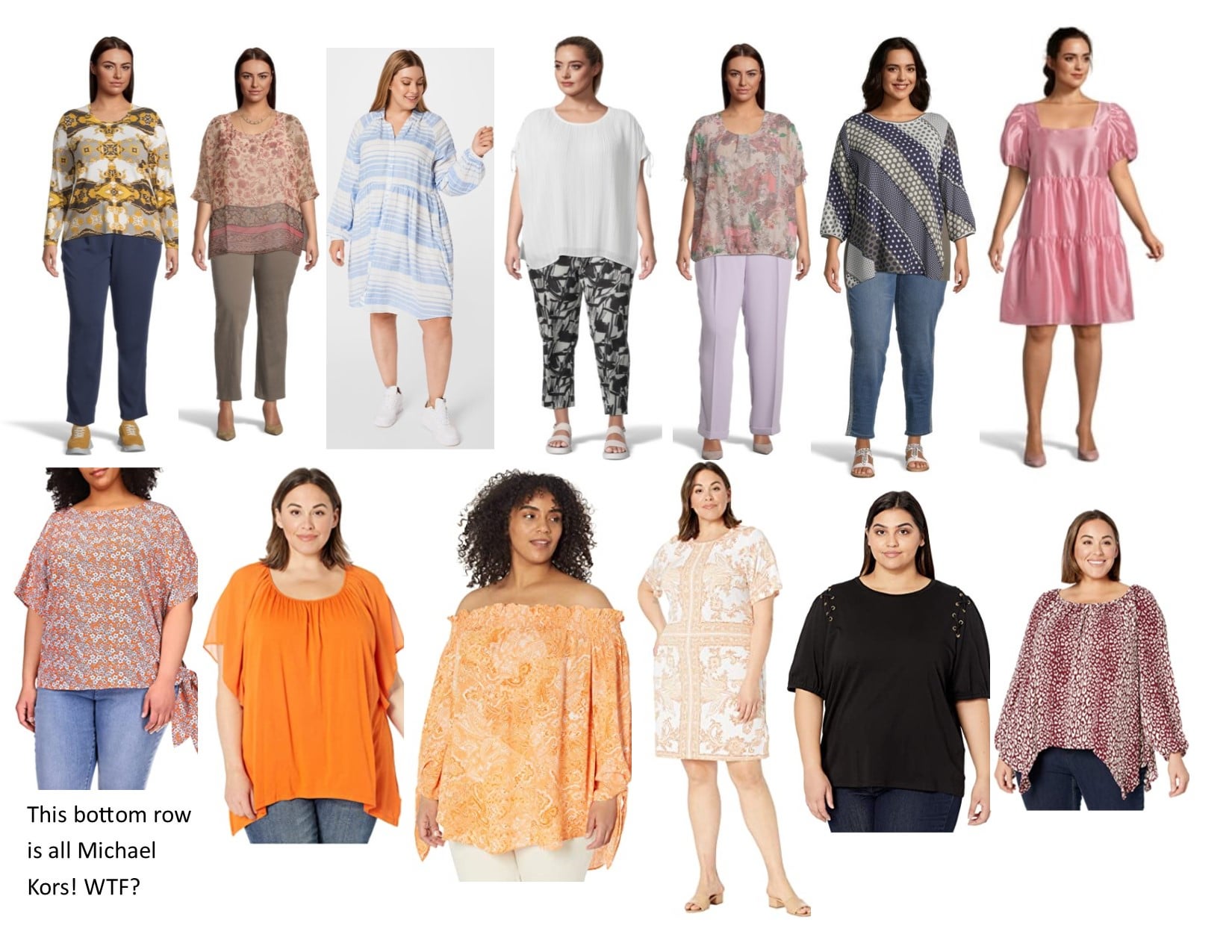
“Universally flattering” is a phrase that gets used in three places. In brand marketing copy, it means “the sample size sells through fast.” In editorial captions, it means “this looked good on the model in the lighting we had.” On the For You Page, it means “you should feel bad if this didn’t work on you.” None of those three usages is about the garment doing universally flattering work across bodies, because no single garment cut on one block does that.
What it actually means, in the industry, is “we tested this on one body type and it worked.” The viral reference images that started the column conversation were photographed on a single body. The garments were chosen for the body in the photographs. The trend that came out of them does not contain a clause about which pattern blocks to ask for at your size, and that absence is the marketing.
The honest version of the trend, at five different sizes, is what was on the steam pipe for eight days. At 10, the body does the work and the clothes get the credit. At 14, the trend works if you swap one or two straight-size pieces for plus-graded equivalents. At 18, the cut starts arguing back, and the fix is a princess seam and a sized-up rise. At 22, the trend has to be rebuilt from plus-pattern brands that engineer the curve into the pattern. At 26, the column has to be reconstructed inside a dress that is doing its own structural work. All five looked tonal. All five looked beige. None of them was the same garment build, and the difference is the part the captions skip.
The honest version of the rule is simpler. The garment that flatters one body is engineered for that body. Anything else is a marketing claim.
Back on the steam pipe, on the last afternoon of the shoot, I un-taped the reference screenshots and stood in front of the five outfits in a row. Bone slip, oat shell, sand silk-cotton overshirt at size 10. The same stack with the Anthropologie Plus overshirt swapped in at size 14. The Universal Standard princess-seamed bone skirt with Tee Rex and an oversized sand shirt at size 18. A Marina Rinaldi heavier-weight trouser with Eloquii shell and an oversized Eloquii boyfriend shirt at size 22. An Eloquii princess-seamed column dress under a Marina Rinaldi cashmere cardigan at size 26. From across the studio they looked like a single trend at five sizes, exactly as the captions promised. From three feet away they were five different construction problems with five different answers. Both versions of that statement are true at the same time. The For You Page only shows you one of them.