
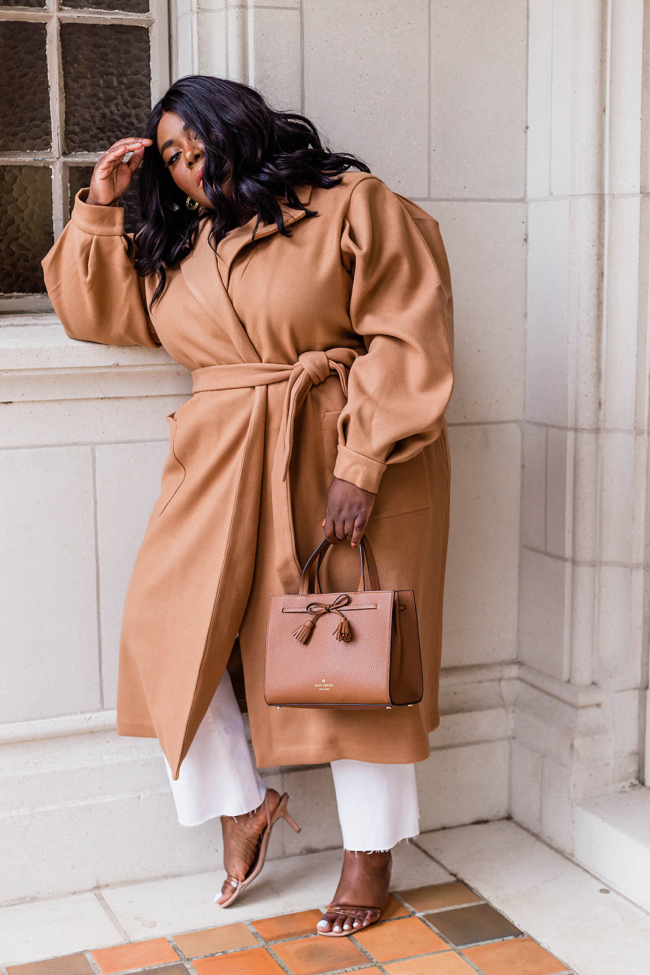
The blazer was hanging on a rack in a Marina Rinaldi boutique on Rua Garrett in Lisbon, the one tucked into the side street between the bookshop and the gelato counter where the espresso runs eighty cents and the tourists do not bother to wander. Caramel wool, structured shoulder, fully canvassed front, the kind of make I had been hunting in Manhattan for six straight months without finding anything under twelve hundred dollars that fit a size 22 body without a tailor’s bill behind it. The Lisbon price tag said 690 euros. The associate ran a size 24 from the back. The shoulder seam landed where my actual shoulder ends, the lapel rolled instead of pressed flat, the buttonhole was hand-stitched. I stood in front of the mirror for a long minute and did the math twice. By the time I added the VAT refund out, the customs duty back in, the international shipping the brand quotes on the US site, and the fact that the Lisbon stock was already on a small end-of-season markdown the e-commerce site does not honor, the same blazer landed in Brooklyn for about $1,090 instead of the $1,475 the US site listed. Real saving. Real win. And the shipping math killed sixty percent of what the boutique price had promised.
That is the European plus-size retail story for an American shopper in one shop visit. The carry actually does go deeper at certain price points than the US equivalent, especially in Italian and German plus, where the patternmaking tradition was not built off a sample size 4. The fabrics are heavier, the linings are real, the alterations are anticipated rather than treated as a customer-service failure. But the shipping cost, the customs duty above the de minimis threshold, the conversion math at the bank’s daily rate, and the return-shipping reality on a piece that does not fit eat most of the boutique-price advantage by the time the box reaches a New York or Atlanta or Chicago address. The question for a US plus-size buyer in 2026 is not whether European retailers ship to you. Many of them do. The question is which five are worth the customs paperwork after you finish the math, and which ten are a tourist purchase you should make in person if you are already on the continent and skip otherwise. This is the read on fourteen of them, the brands I have shopped in person across Lisbon, Lagos, Berlin, Milan, Rome, Munich, Paris, Copenhagen, and Amsterdam in the last four years, with current 2026 prices and the landed cost a Brooklyn or Houston buyer actually pays once everything clears customs.
Why European retail goes deeper at certain price tiers
Stephanie Yeboah, the London-based plus-size journalist who wrote the 2020 book Fattily Ever After and has filed for Refinery29 UK, Vogue, and the Guardian on the state of UK plus retail, has been saying for the better part of five years that the structural difference between US and European plus is not the size range. Both markets have brands that go to a UK 32 or a US 28. The difference, Yeboah has argued in print and on her newsletter, is which tier each market chose to build out first. The US plus market grew up around mid-market mass: Lane Bryant, Torrid, Avenue, then later Eloquii and ASOS Curve. The premium and luxury tiers were filled in late, badly, and mostly by smaller US brands that struggled to survive past the seed round. The European plus market grew the other direction. Marina Rinaldi launched in 1980 in Italy as the plus-size sister to Max Mara, and the brand has had forty-six years to perfect a 690-euro wool blazer for a size 24 body. Anna Scholz launched in 1996 in London with a German design tradition behind her and built a contemporary-luxury line that the US plus tier still has not reproduced. The premium and luxury rungs of the ladder were built first in Europe and the mid-market filled in around them, the opposite of the US sequence.
What that means in a fitting room is concrete. The grading is more honest. The shoulder seam on a Marina Rinaldi blazer at size 24 was engineered for a size 24 body, not extrapolated from a sample size 42 Italian, which is roughly a US 6. The bust-to-waist ratio on an Anna Scholz dress at UK 24 sits where a UK 24 body actually sits, not where a UK 8 body stretched eight sizes larger would put it. The German plus tier, which centers on Navabi as the aggregator and Sheego as the basics brand, runs heavier-weight fabrics than the US mid-market equivalents at the same price point, because the German market expects a winter coat to last six winters and the US fast-fashion plus tier has trained shoppers to expect one. None of this matters if you do not buy at the premium tier. At ASOS Curve and Simply Be price points, the European mass market is similar to the US mass market and the shipping math kills the comparison. Above 200 euros per piece, the European tier separates itself and is worth the customs paperwork. Below 200 euros per piece, you are mostly paying for a different sticker on the same Bangladesh garment.
ASOS Curve and Simply Be: the UK mass-market tier
ASOS Curve is the most familiar name to a US plus shopper and the one with the most genuinely useful US shipping setup. The brand carries UK sizes 18 through 30, which translate to roughly US sizes 14 through 26, on around 14,000 styles at any given moment across its own label and the third-party brands stocked on the marketplace. Pricing in 2026 runs from 12 pounds for a Curve tee to about 95 pounds for an outerwear piece, with the bulk of the catalog sitting between 25 and 55 pounds per item. The US site quotes free standard shipping on orders over $40, paid express around $20, and the brand has been clearing US customs on the de minimis side of the line at item level for years, which means a Brooklyn shopper buying three Curve dresses at 45 pounds each lands the order for about $172 with no customs duty owed at the door. That is the cleanest math in this entire piece.
The trade-off is what the brand actually is. John Lyttle, the ASOS chief executive who took over in 2024 after the Nick Beighton restructuring, has been public about the strategic decision to consolidate the Curve sub-brand under the main label and reduce duplicate SKUs across the size ranges, which in practice has meant a smaller Curve offering in 2026 than the brand carried in 2022. The quality is fast-fashion quality. The Curve denim wears for a season and bags at the knee. The Curve dresses pill on the polyester knits after eight wears. The brand grades up from a UK 10 sample, and the fit at UK 28 is consistently the weakest in the size run, with armholes too high and waist placement too forward. For a US shopper, the case for ASOS Curve is breadth of stock, occasional steals on the marketplace brands like Simply Be and Yours Clothing stocked through ASOS, and the lowest landed-cost math of any European retailer that ships to the US. It is not the place to buy something you expect to wear past eighteen months.
Simply Be sits in a similar tier with a different demographic. The brand is owned by the N Brown Group in Manchester, carries UK sizes 12 through 32, and runs heavier on workwear, denim, and lingerie than ASOS Curve does. Prices in 2026 sit between 22 and 75 pounds for most styles, with a denim core at 35 to 45 pounds and the brand’s own Simply Be label workwear hitting 55 to 75 pounds. The US site quotes flat shipping at about $14.99 for standard delivery and $24.99 for express, with no free-shipping threshold most of the year. For a Brooklyn shopper, a Simply Be order of three pieces at an average 40 pounds each lands at roughly $169 plus the $14.99 shipping, total around $184. Customs clears on the de minimis side as long as the order is under $800. The brand grades better at the top of the size range than ASOS Curve does, especially through UK 28 to 32, where Simply Be’s denim retains a better waistband-to-hip ratio than the ASOS equivalents. The trade-off is the catalog leans frumpier and the trend pieces lag UK street style by about a season.
Marina Rinaldi: Italy’s plus luxury and the alterations economy
Marina Rinaldi is the brand the entire European plus tier is measured against. Founded in Reggio Emilia in 1980 as the plus-size sister label to Max Mara, the brand carries Italian sizes 41 through 55, which translate to roughly US sizes 12 through 26, across about 600 styles a season split between the main Marina Rinaldi line, the contemporary Persona by Marina Rinaldi line, and the suiting-focused Marina Sport line. Pricing in 2026 sits at the premium tier and does not pretend otherwise. A wool Marina Rinaldi blazer runs 590 to 890 euros at the boutique. A cashmere coat runs 1,200 to 1,800 euros. A silk-blend day dress runs 380 to 590 euros. The trousers sit at 280 to 420 euros. These are not aspirational prices, they are the actual prices on the floor at the Milan flagship and the Lisbon boutique and the Rome store on Via del Corso.
The brand ships to the US through marinarinaldi.com at quoted rates of $35 to $50 for standard delivery on most orders, with express available around $75. The shipping is the cheapest part of the math. A Marina Rinaldi blazer at 690 euros converts to roughly $750 at the 2026 rate, then the brand adds about $40 in shipping, then because the order is over the US $800 de minimis threshold for duty-free entry, US Customs assesses duty on the apparel category at roughly 16 to 28 percent depending on fabric content. For wool blazer construction, expect about 18 percent. The landed cost on that 690-euro Lisbon-boutique blazer ordered to Brooklyn lands closer to $930 to $960 once the duty clears. That is still meaningfully under the $1,475 US site price, but the win is sixty percent smaller than the boutique-floor delta suggested. The premium tier shopper who buys multiple Marina Rinaldi pieces per year can amortize the shipping, but the customs duty resets on every order regardless of frequency.
The piece I keep recommending to US Marina Rinaldi shoppers is the alterations math. The brand cuts trousers and dresses with an inch of extra fabric in the waistband and hem on purpose, with finished seams, on the assumption that the buyer will tailor. A Marina Rinaldi trouser ordered to your size 24 measurements in Italy will arrive with about thirty dollars of alterations work waiting at your local tailor. Budget for that. The US plus mid-market does not anticipate alterations and finishes the seams flat, which is why most US plus trousers cannot be let out half an inch in the waist. Marina Rinaldi expects the trip to the tailor and prices the garment for the buyer who will make it. That is the actual luxury, not the wool weight.

Persona by Marina Rinaldi: the contemporary line
Persona by Marina Rinaldi is the sub-line the brand launched to capture the contemporary plus tier, sized Italian 41 through 49, US 12 through 22. The cut is softer, the silhouettes more current, the price point about thirty percent below the main Marina Rinaldi line. A Persona blouse runs 220 to 320 euros, a Persona dress 290 to 480 euros, a Persona blazer 380 to 520 euros. The shipping to the US is bundled with the Marina Rinaldi US site at the same $35 to $50 standard rate. The landed cost on a 390-euro Persona dress to Brooklyn comes in around $475 if the order stays under the $800 de minimis ceiling, which a single-dress order will. Bundle two Persona pieces in one order and you cross the threshold, the duty assesses, and the per-item math shifts.
The honest take on Persona is that it is the better entry point to the Marina Rinaldi house than the main line for a US buyer who does not want to wait through the customs paperwork on every order. The fit grading is the same patternmaking team. The fabrics are lighter, the lining is sometimes optional, but the construction is recognizably Italian premium. A US shopper buying her first Italian plus piece should start at Persona. If the size and the silhouette work, then the main Marina Rinaldi line is the upgrade after the first piece confirms the body translates.
Navabi: the Germany plus aggregator
Navabi is the German plus aggregator, launched in 2009 out of Aachen as a multi-brand plus-size e-commerce site. The site stocks about forty-five plus-size brands from across Europe, German sizes 42 through 58, US sizes 12 through 28, with pricing that ranges from 60 euros for a basic knit to 800 euros for the Anna Scholz pieces the site carries. Navabi’s structural value is that the site curates rather than sells everything. The buying team filters out the brands that grade badly at the top of the size range and stocks the ones that hold up. A US shopper who does not want to research individual European brands can hit Navabi, filter by size and category, and the site has already done the brand-quality sort.
The shipping to the US is the cleanest in the German plus tier: Navabi charges a flat 25 euros to the US for standard delivery, about $27 at the 2026 rate, regardless of order size. The customs math is the same as everywhere else, de minimis under $800, duty above, but Navabi pre-calculates the duty at checkout and presents a delivered duty-paid price that includes the customs in the cart total. That is the buyer-friendly version of the math, and it is the reason I send first-time European plus shoppers to Navabi before any other site. A Brooklyn order of two pieces at an average 180 euros each lands at $415 total with the duty and shipping already calculated. No surprise bill at the door. No piece held in a CBP warehouse for a week while the duty broker negotiates classification. Navabi has built the shipping experience that the rest of the European plus tier still has not.
Anna Scholz: the German designer plus
Anna Scholz is the contemporary-luxury German plus designer, German-born and London-based, who launched her label in 1995 after studying at Central Saint Martins, sized UK 14 through 28, US 12 through 26. The label is one of the few European plus brands that carries through to a UK 28 with the same grading attention as the bottom of the run, which is the reason the brand sits in nearly every Navabi feature edit. Pricing in 2026 sits at the upper-contemporary tier: dresses 350 to 580 pounds, knits 220 to 380 pounds, outerwear 480 to 890 pounds. The brand sells direct through annascholz.com, ships to the US at about 35 pounds standard, and clears customs at item level on orders under $800.
The fit signature is dramatic. Anna Scholz cuts on the bias more aggressively than the rest of the European plus tier, uses jersey weights that drape rather than skim, and runs prints that read on the body rather than getting lost on it. The pieces are not for every plus body, and the brand makes no pretense at universal flattery. A US buyer who already knows her style runs on the maximalist side should look at Anna Scholz seriously. A US buyer who wants a quiet workwear blazer should not start here. The landed cost on a 380-pound jersey dress to Atlanta lands around $520 with shipping and conversion, and the duty stays off the bill if the order stays single-item.

Sheego and Bonprix Curve: the German basics tier
Sheego is the German mass-market plus brand, sized German 40 through 58, US 10 through 28, the rough equivalent of a Simply Be in scale and price tier but with the German market’s heavier basics tradition behind it. The brand’s catalog runs about 8,000 styles, 25 to 95 euros per piece, with a strong workwear and outerwear core. The US shipping is the soft spot. Sheego does not run a dedicated US site, and the German site quotes international shipping at 39 euros for standard delivery, with no express option to the US in 2026. The customs clears at de minimis under $800, and Sheego’s average ticket is low enough that nearly every US order stays under the threshold. A three-piece order at an average 65 euros lands at roughly $250 to a Brooklyn address with the shipping.
The honest read on Sheego for a US buyer is that the prices, after the 39-euro shipping, are not meaningfully different from the US mid-market equivalents at Old Navy plus or Eloquii sale. The German construction is slightly better at the basics level. The wool-blend coat at 159 euros in the Sheego winter catalog is heavier than the Old Navy coat at $89 in the same season. But the delta does not survive the shipping math for most pieces. Sheego is worth the order if you are buying a winter coat or a structured wool skirt that the US market does not stock at that price tier. It is not worth the order for basics that ship from a US warehouse in two days for the same money.
Bonprix Curve is the catalog plus sub-brand owned by the Otto Group in Hamburg, sized German 44 through 58, US 14 through 28. The pricing is the bottom of the European plus tier: most pieces sit between 15 and 50 euros, with a fast-fashion-adjacent rotation. Bonprix runs a dedicated US site that ships standard at about $9.95 to most addresses, which is the cheapest European plus shipping in this piece. The trade-off is that you are buying European fast fashion, and the construction shows it. The pieces wear for a season at most. For a US buyer, Bonprix Curve makes sense only if you are looking for a specific basic the brand stocks in a colorway the US fast-fashion plus tier does not offer. Otherwise the math is a wash with Walmart plus or Target plus at lower landed cost.
Yours Clothing: the UK fast-fashion plus reality
Yours Clothing is the UK fast-fashion plus chain, sized UK 16 through 36, US 12 through 32, with the deepest top-of-range carry of any brand in this piece. The catalog runs about 6,000 styles at any given time, priced 14 to 65 pounds for most pieces, with a strong occasionwear and denim presence. The US shipping is quoted at 12 to 18 pounds depending on order size, with free shipping over 75 pounds occasionally during promotions. The customs clears at de minimis on nearly every order.
The case for Yours Clothing is the size 32 range. There is no US fast-fashion brand that carries to a US 32 with the same breadth of stock and consistency of fit. A US 30 or 32 shopper who has been forced into the same five Lane Bryant denim styles for years can hit Yours and find twenty-five denim styles in her size in current season. The construction is fast-fashion construction, comparable to ASOS Curve at the same price tier, and the pieces are not meant to last past a season. The trade-off is real, but for a buyer at the top of the US plus range who has been underserved by domestic stock, Yours Clothing’s catalog depth is the closest thing to mass-market choice that exists. Felicity Hayward, the UK plus-size model and author of the 2023 book Found , has been writing for years about the way the UK plus market built capacity at sizes 26 through 36 that the US market still has not matched at any price tier, and Yours is the most accessible expression of that capacity.
KOAN and Elena Miro: the Italian contemporary and mid-tier plus
KOAN is the Italian contemporary plus label out of Milan, sized Italian 46 through 56, US 14 through 24, that has been quietly stocked in the Navabi feature edit and a handful of US boutique e-commerce sites for the last three years. Pricing sits in the 180 to 480 euro range, with a strong knitwear core and the Italian premium-tier fabric weights at a contemporary price step. KOAN does not run a dedicated US site as of 2026, and US buyers reach the brand through Navabi or through the brand’s Milan boutique direct-order. The Navabi pricing on KOAN pieces averages about 240 euros, lands at $290 to Brooklyn through Navabi’s flat 25-euro shipping, and clears the customs math on the duty-paid side.
Elena Miro is the older Italian plus brand, founded in 1985 in Mantua, sized Italian 42 through 54, US 12 through 22. The brand sits between Marina Rinaldi’s premium and KOAN’s contemporary, with prices in the 120 to 380 euro range. Elena Miro ships to the US through elenamiro.com at about 30 euros standard, lands customs-cleared on most orders under $800, and the brand’s signature is the cocktail dress and Italian eveningwear core that the US plus market has consistently underserved. For a US buyer looking for a real occasion dress at a contemporary-Italian tier, Elena Miro is the search-result-worth-clicking on a price-per-construction basis. The trade-off is that the silhouettes lean conservative, more Reggio Emilia matron than Milan street, and the buyer should know that going in.
Olympia: the Greek plus brand most Americans have not heard of
Olympia is the Athens-based plus-size brand sized Greek 46 through 60, US 14 through 28, that has been operating since 2012 with a small but consistent US-shipping operation. The catalog is small, about 400 styles a season, priced 45 to 220 euros, with a Mediterranean cut tradition that runs lighter than the German or Italian plus equivalents. The brand ships to the US at about 28 euros standard through olympia.gr, clears customs on de minimis under $800, and the Greek summer-wardrobe pieces, especially the linen separates and the gauze-cotton dresses, are the search the US plus market has not built capacity for at this price tier. A Brooklyn buyer planning a Mediterranean trip can order from Olympia directly to her hotel address, which is the move I have used three times now to dodge the customs paperwork entirely. Olympia is not a US-residency brand for most buyers, but it is the brand to know about if you are traveling.
Penningtons: the Canadian plus that carries some European stock
Penningtons is the Canadian plus chain owned by Reitmans, sized Canadian 14 through 32, US 12 through 30, which carries a rotating selection of European plus brands alongside its house label. The brand ships to the US at flat Canadian Post rates, about $19.95 USD for standard delivery, and clears customs at the de minimis threshold on most orders. The case for Penningtons for a US buyer is the curated European edit at the top of the size range, especially the Anna Scholz and Marina Sport pieces the chain stocks at slightly under the European direct-order price after the Canadian buying-team markup. The trade-off is the stock turns fast and the European edit is not predictable. Check the site at the start of each season if you are sourcing European plus through the Canadian back door.
The Violeta by Mango closure and what it cost us
Violeta by Mango was the Spanish plus sub-line that Mango launched in 2013 to carry sizes EU 42 through 52, US 14 through 22, at the contemporary fast-fashion price tier. The brand closed the sub-line in late 2022, folded the upper sizes into the main Mango range, and reduced the actual top-of-size carry from a EU 52 to a EU 46 across most styles within eighteen months of the closure. Stephanie Yeboah wrote a Refinery29 UK piece at the time arguing that the Violeta closure was the leading indicator of the broader pullback in plus inclusion that has continued through 2025 and 2026. She was right. Anna Scholz commented on the closure in an Instagram post, calling it “the canary in the coal mine for European plus” and warning that the Spanish and French mid-market would follow within three years. Two of the three brands she named publicly have in fact reduced their top-of-range carry since.
What the Violeta closure cost US shoppers specifically was the contemporary Spanish plus price tier. There is no current European brand that occupies the slot Violeta held: 50 to 120 euro contemporary trend pieces, EU 50 through 52 top-of-range, with the Mango aesthetic and a US shipping setup. The closest equivalents are KOAN at twice the price tier and Bonprix Curve at half the construction quality, neither of which actually replaces what Violeta was doing. For a US buyer who built her wardrobe around Violeta between 2017 and 2022, the replacement is partial. The Marina Sport line at Marina Rinaldi covers some of the same wardrobe slots at three to four times the price, and Anna Scholz covers the editorial silhouettes at a similar multiple. The fast-fashion contemporary Spanish plus tier is gone and the European market has not rebuilt it.
The shipping cost and customs duty math you need to know
The single biggest change in this math for any US plus shopper ordering from Europe in 2026 is what happened to the de minimis exemption. The $800 duty-free entry threshold that long defined the international apparel order was suspended by executive order on August 29, 2025, which means low-value shipments from all countries are no longer eligible for the old duty-free treatment and are subject to standard admissibility and duty assessment at entry. The practical effect for a US plus buyer is that the customs duty math now applies to nearly every European order, regardless of order size, rather than only to the large premium-tier orders that used to cross the old threshold. Some retailers are absorbing the duty into checkout under a delivered-duty-paid model and some are passing the assessment through at the door via the carrier. Confirm which model your retailer is using before you place the order, because the difference at the door can be 15 to 25 percent of the cart value.
The customs duty on apparel runs roughly 12 to 32 percent depending on fabric content and garment classification. Wool blazers and wool coats sit at the high end, around 18 to 25 percent. Cotton knitwear sits in the middle, around 14 to 18 percent. Silk and synthetic blends vary widely, 12 to 28 percent. Customs also assesses a merchandise processing fee on formal entries. The duty is calculated on the value of the goods plus the international shipping, not the goods alone. For a Marina Rinaldi blazer at 690 euros plus 40 euros shipping, the duty assesses on the full 730 euros, which is roughly $795 at the 2026 rate. At an 18 percent rate that’s around $143 in duty plus the processing fee, which adds roughly $175 at the door to the original $750 piece. The landed cost lands close to $965. That’s the math the boutique-floor price didn’t tell you.
For shipping cost specifically, the spread is wider than most US buyers expect. ASOS Curve runs free shipping over $40 to the US. Bonprix Curve runs about $9.95 flat. Navabi runs about $27 flat at any order size and pre-calculates the duty. Yours Clothing runs $14 to $22. Sheego runs about $42. Marina Rinaldi runs $35 to $50. Anna Scholz runs about $40. Elena Miro runs about $32. Olympia runs about $30. KOAN ordered direct through the Milan boutique runs about $55 to $75 with the higher-touch hand-off, which is why most US buyers route KOAN through Navabi instead. The retailers with the cheapest shipping are not necessarily the ones with the best landed-cost math, because the cheapest shipping correlates with the cheapest construction. Navabi’s $27 flat with pre-calculated duty is the most predictable single shipping number in the European plus market, and Marina Rinaldi’s $40 with the duty assessed at the door is the most expensive but the most negotiable, because the brand will sometimes waive the international shipping fee on orders above 1,500 euros placed direct through the boutique with a sales associate.
Sizing translation EU to US plus
The conversion math European plus retailers publish on their US-facing sites is not reliable. The cleanest rough conversion across most European brands is: US 14 equals roughly UK 18, German 44, Italian 46, French 46, Spanish 44. US 18 equals roughly UK 22, German 48, Italian 50, French 50, Spanish 48. US 22 equals roughly UK 26, German 52, Italian 54, French 54, Spanish 52. US 26 equals roughly UK 30, German 56, Italian 58 (where carried), French 58 (where carried). The variance between brands is wider than the variance within a single brand, which means the size that fits at Marina Rinaldi will not necessarily fit at Anna Scholz at the same nominal conversion. Order one size up from your conversion on the first piece from any new European brand, because the European return shipping math is brutal at the international tier and a piece that fits poorly is functionally non-returnable for most US buyers.
The specific size-translation gotcha is the bust grading. European plus brands grade the bust from a smaller starting point than US plus brands at the same nominal size, because the European reference body assumes a smaller cup. A US 22 with a DDD bust will often need to size up at Marina Rinaldi for the blazer to button at the bust, even though the trouser will fit at the converted size. Buy separates rather than suits as your first European plus order, and let the bust grade tell you what size to repeat-buy in the next category. Naomi Shimada, the multidisciplinary plus-size advocate and former model who has written for the Guardian and The Cut, has been pointing out for the last several years that the European bust-grading tradition is the structural reason so many European plus brands fit hourglass and pear bodies better than apple bodies. She is right, and that fit pattern is worth knowing before you spend 690 euros on a piece that will not button.
The five retailers actually worth the shipping math
After the math is run, the European plus brands that survive the customs-and-shipping reality on a value-per-piece basis for a US buyer come down to five. Marina Rinaldi is the first, because the construction at the premium tier is genuinely not available at the equivalent US price, and the landed-cost delta on a wool blazer or cashmere coat from the Lisbon or Milan boutique compared to the US site still favors the buyer who runs the order through the international shipping rather than the US-domestic restock. Anna Scholz is the second, because the contemporary-designer plus tier the brand occupies has no real US-domestic equivalent, and the 380-pound jersey dress lands at $520 in Atlanta in a category the US plus market does not stock. Navabi is the third, because the aggregator’s flat-rate duty-paid shipping math is the cleanest in the European plus market and the buying team’s curation removes the brand-quality research that otherwise eats a US buyer’s time. Yours Clothing is the fourth, narrowly, because the size 28 through 32 carry depth is genuinely not available at any US fast-fashion price tier and the shipping math survives at the lower per-piece values. Persona by Marina Rinaldi is the fifth, because the entry-point construction at 290 to 480 euros per piece, on the Marina Rinaldi house grading, lands as the smartest first European plus order for any US buyer who has not yet tested the size translation on a premium-tier piece.
The brands that did not make the cut are not bad brands. ASOS Curve fails the value math because the US-domestic alternatives at the same price tier have caught up and the construction is comparable. Simply Be fails because the catalog leans frumpier than the US mid-market equivalents at the same landed cost. Sheego fails because the shipping eats the construction delta on most pieces. Bonprix Curve fails because the construction is fast fashion at international shipping prices. KOAN fails the direct-order math but survives through Navabi, which is the reason Navabi made the cut and KOAN did not. Elena Miro fails because the silhouettes are conservative enough that the US plus market’s evening-and-cocktail tier covers the same buyer at lower landed cost. Olympia fails the US-residency math but works for travelers ordering to a hotel address. Penningtons fails because the European-edit curation is too inconsistent to plan an order around. Marina Sport survives the math but folds into the Marina Rinaldi recommendation. The Violeta by Mango slot is empty and will likely stay empty for the next several years.
What I think happens to European plus US shipping in 2027 and 2028
Here is the prediction. By the end of 2028, two of the five brands above will have expanded their US shipping operations meaningfully, and three of the brands below the cut will have retracted theirs. Navabi will expand. The aggregator model with pre-calculated customs duty is the buyer experience the rest of the European plus tier has not built, and Navabi’s German operations team has been quietly hiring US-market logistics roles since late 2025 in a way that signals a real US-side warehouse or duty-broker partnership inside two years. Marina Rinaldi will expand at the Persona tier, not the main line, because the contemporary-luxury price step is where the US plus premium tier still has the largest gap and Marina Rinaldi’s parent company at Max Mara has been treating the US as a growth market in the Persona positioning since the 2024 New York store opening. The main Marina Rinaldi line will hold steady at current US shipping because the buyer base is already captured at the boutique-direct order tier.
The retractions will come from Sheego, Bonprix Curve, and Yours Clothing, in that order. Sheego will pull back US shipping or raise the international rate to a level that prices the brand out for most US buyers, because the Otto Group’s German-market focus does not justify the international logistics overhead at Sheego’s average ticket size. Bonprix Curve will follow Sheego inside eighteen months for the same reason. Yours Clothing will not pull US shipping outright, because the N Brown Group’s mid-market positioning needs the US revenue, but the brand will likely shift to a US-fulfillment-partner model that raises prices by twenty to thirty percent on the US-facing site to absorb the shipping cost into the ticket. Anna Scholz will hold steady, because the designer-direct model does not depend on volume. Elena Miro will hold steady at current shipping but lose US buyers anyway as the US plus eveningwear category fills in domestically. KOAN will get bought by either the Max Mara group or the Navabi parent, and the brand’s US distribution will consolidate through the acquirer rather than through direct-order. The Violeta by Mango slot stays empty through 2028 because the European fast-fashion plus tier is structurally retreating, and no Spanish or French replacement brand has the scale to enter the US at that price point with the same catalog breadth. By the end of 2028, the European plus shipping math for a US buyer will be cleaner at the premium and aggregator tiers and meaningfully worse at the mass-market tier. Navabi will become the default and the rest will sort itself behind that single fact.